


31 October 2024
The Eyes Have It is a partnership of Macular Society, Fight for Sight/Vision Foundation, RNIB, Association of Optometrists, The Royal College of Ophthalmologists, and Roche. Roche has funded the activities of the partnership.
MPs and key stakeholders in the eye care sector came together in the Houses of Parliament to celebrate Westminster Eye Health Day this week (Tuesday, 29 October).
The event was organised by The Eyes Have It (TEHI), a partnership that works to raise awareness and demonstrate the importance of eye health amongst policymakers. The day was hosted by Marsha de Cordova MP.
The partnership includes the AOP, the Royal College of Ophthalmologists, Roche, Fight for Sight/Vision Foundation, Macular Society, and Royal National Institute of Bind People.
Speaking to OT, AOP chief executive, Adam Sampson, called the event an opportunity “to engage with as many MPs as we can, to continue to promote the idea of eye health, and particularly a national plan for eye health as widely as possible in the political circumstances.”
Now is a particularly important time to push forward the eye health agenda, Sampson believes.
“Obviously, we now have a new government,” he said. “We also have a government which has explicitly mentioned optometry as part of its agenda. We have a 10-year plan for health, which is being created. All those things give us an opportunity to promote eye care in general, eye health in particular, and optometry.”
Peter Bloomfield, director of research at the Macular Society, which is a partner of TEHI, told OT: “It’s really nice to articulate what we’re doing, and gain support from a much wider audience.”
Speaking about the day, Bloomfield noted strong engagement from attending MPs.
“It has been really refreshing that everyone we have spoken to has recognised the challenges,” he said.
“They understand the need for a plan, particularly integrating it across different delivery modalities, and really making sure that no one is left behind based on their region or any kind of inequalities that they might face as part of the system,” he added.
Westminster Eye Health Day 2024 took a different format to previous years, allowing for more focused one-on-one conversations between MPs and TEHI partners. Around 30 MPs attended throughout the afternoon.
The conversations allowed TEHI partners to “get into the nitty gritty of policy,” Amy Craddock, research and policy associate at the Royal National Institute of Blind people (RNIB), told OT.
“While calling for a national eye care plan, I think each partner has something specific they want to say about what we want to see in eye care,” Craddock said.
She added: “It’s really important we all come together, as a whole sector, to talk about the changes we need to see. Optometrists play a huge role in transforming eye care, so it’s really important that they are involved.”
Speaking from an optometry perspective, AOP Board member and optometrist, Ankur Trivedi, noted the postcode lottery for eye care and inequalities in commissioning in England as the most important factors to emphasise to MPs.
The day provided “the opportunity to speak to MPs, making them aware of the issues that we have in community optometry and primary care, around trying to deliver good eye health care for our patients,” Trivedi said.
Invested MPs
Cat Eccles, MP for Stourbridge in the West Midlands, has a background in ophthalmics and worked for the NHS for 20 years, as well as for private providers. She attended Westminster Eye Health Day to see “what I can do for the health sector – what asks I can make to government.”
After being newly elected at this summer’s general election, Eccles now wants to speak to MP colleagues, “about my own insights, my own experience, and how that can feed into how we develop policies and future funding.”
During the event, attendees and MPs had the opportunity to don a virtual reality headset that allowed them to experience the vision of someone with increasingly severe levels of age-related macular degeneration.
The device allowed wearers to experience “how frustrating it is to have this condition, and why it is important,” Dr Santanu Chattopadhyay, medical affairs partner at Roche, told OT.
“Through this headset, we are trying to showcase how a patient with macular degeneration feels, and what their vision is like,” he said.
He added: “The message is that, if this disease is left untreated, progress is very difficult to reverse. If you detect it early, through High Street optometry, you can pick it up early and treat it, and then you can create a referral pathway.”
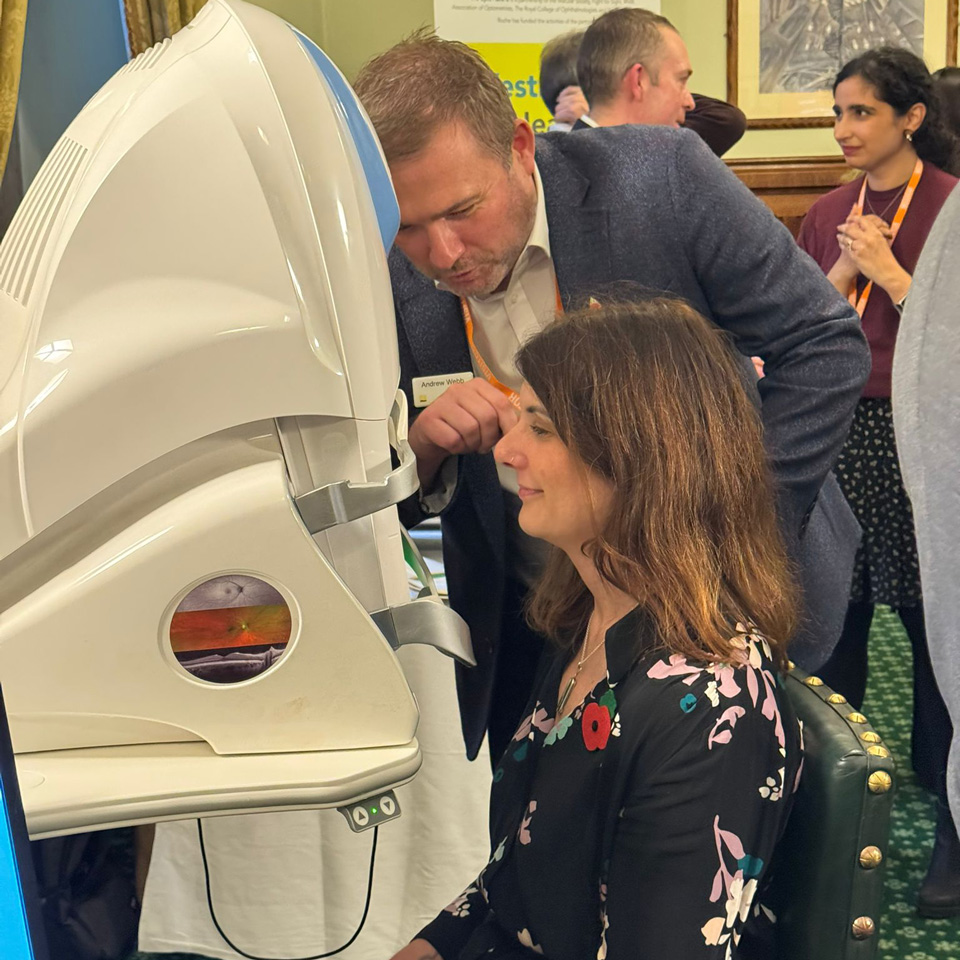
MPs, including Eccles, also had the opportunity to have optical coherence tomography (OCT) and Optomap scans taken during the event.
A coalition of organisations
Jordan Marshall, policy manager at the Royal College of Ophthalmologists, spoke to OT about the value of TEHI partnership.
“It’s great that we have this coalition of organisations,” Marshall said. “We’ve managed to bring all these parliamentarians together to talk about the importance of eye care, and the need for a national plan.”
Marshall told OT that TEHI has secured a meeting with Stephen Kinnock, the primary care minister, for the near future.
This shows the value of the partnership working in practice, Ali Rivett, chief executive of the Royal College of Ophthalmologists, said.
“We might not have the opportunity to speak to some of these parliamentarians as an individual organisation,” Rivett said.
“Coming together as a community, we speak with a more powerful, collective voice.”
Moving forward pragmatically
Ellie Southwood, director of impact at Fight for Sight/Vision Foundation, noted TEHI’s Laying the foundations for the future of eye health in England report, which was published in late 2023.
A year on from the report, it is time for practical measures around a national eye health plan to come to the fore, Southwood told OT.
“We have been working hard as a partnership to put some flesh on the bones of our report, which we launched this time last year, calling for a national eye care plan,” she said.
“Obviously, [that has meant] lots of work behind the scenes, looking at what that might mean and some of the practical interventions, which we are now ready to talk to government about.”
Southwood added that the afternoon’s conversations were “really good, really positive, from people for whom this is quite a new issue, to people who are affected in their own families and therefore have a real lived experience of what it is like to have family members and loved ones with eye conditions.”
Ensuring that MPs speak to those with lived experience, Southwood said, “really helps to increase the understanding of the day-to-day impact of what losing your sight is like.”
She added: “It helps humanise things, too. It helps make it about people, not just about systems and structures. Policy can seem quite theoretical, and I think this really helps to bring it to life.”
OT will share further coverage of Westminster Eye Health Day 2024 in its December 2024/January 2025 The Money Matters edition.
More News
-
 New eye clinic liaison officer suite opens at Sunderland Specialist Eye Hospital
 -
 Eye care leaders call on sector to unite behind global compact
 -
 Half of people experiencing homelessness have worsening eyesight or hearing, Specsavers says
 -
 Specsavers practice partners join Thames Path Ultra Challenge in memory of colleague
Comments (0)
You must be logged in to join the discussion. Log in