


03 October 2024
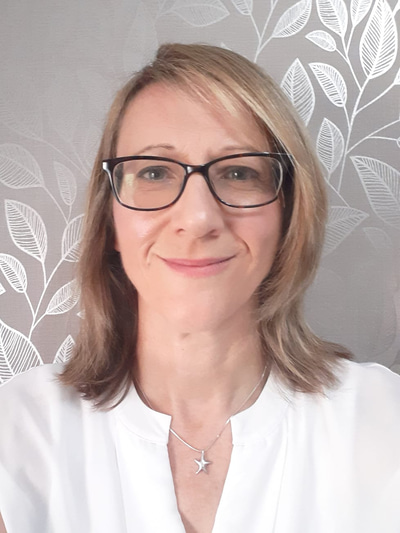
You work as a senior vision rehabilitation specialist for Powys County Council. What does your role entail?
We work, generally, in people’s homes. We look at how a person is functionally coping in their own home, and when they’re out and about, and if there is any way that we can improve that situation for them. That might be through information and advice, equipment, suggestions on how to do something in a slightly different way, or training in practical skills.
We look at all those aspects, alongside daily living skills and the home environment: how is a person managing in the kitchen? How are they coping with preparing meals? Is there any equipment or are there any minor adaptations we can put on their cooker or microwave or air fryer?
It’s anything that means the person then can use it themselves, as opposed to asking a member of their family or a carer. That can be as simple as putting a tactile mark on, which costs a couple of pence. Because it’s colour-contrasting, and because it’s a tactile attachment, we can instruct the person in how to manage that particular task themselves.
There are safety issues, particularly with things like ovens and hobs. For some people, we just mark where the off button is, so they’ve got that security. Some people with good residual vision can see bright orange at the 12 o'clock position, and know that all the dials are turned off. It’s all about independence, and that’s what we prompt.
Your session at the Deafblind UK Conference 2024 is in partnership with Oriel Davies Gallery in Newtown, Powys. How did that relationship come about?
At Powys County Council, we had already started developing our services for people with sight or hearing loss. As vision rehabilitation specialists, we work really closely with our hearing impairment and visual impairment teams, which I know we are lucky to have.
The gallery was straight across the park from where I was working, in the council offices, and I heard that they had an exhibition on sight loss. I was interested in running a visual impairment awareness session, on a voluntary basis, and I was able to find support from colleagues within the council, who also gave up their spare time to help organise it.
During the session, we used simulation spectacles and guided staff and volunteers around the art gallery. They were very good with descriptions, and excellent at taking on board what we were trying to explain.
That led to the art gallery putting on specific sessions for people with sight and hearing loss. They were quite small sessions, run by an artist who also has a disability. She led the group, with support from the volunteers and staff. Again, I attended in a volunteer capacity.
The sessions were fantastic. The atmosphere was very supportive, and really relaxed. Staff in the gallery had really taken their visual impairment awareness training on board, and that really came out in their role in working with individuals on a one-to-one basis. Everybody went home with a piece of artwork that they had made themselves, with support from people they’d brought along, or from the volunteers and the staff. It was absolutely fantastic.
One particular lady has Usher Syndrome, and has been deafblind for the past 25 years. I hadn't realised that she had gone to art college, but had had to stop because of the nature of her disability. She came to the second session, and offered some fantastic ideas about what else could be done.
During my vision rehabilitation assessments with her over the years, I had never picked up that she really enjoyed art. We had never had that conversation. But it came out in that session.
What are you hoping that people take away from your session at the Deafblind UK Conference?
I hope that other people will say, ‘Oh, maybe we can do that.’ I don’t know if there are any other services that have done this. I’d like to think that they have, and it would be interesting to know if so, and if other people have suggestions about how we could improve things.
I’d like to see similar things running, if they’re not already. Planting that seed, so people realise that they could do this, they could tie up with our local authority or a local charity. Charities usually have more resources than local authorities, unfortunately. I have done this in my own time, because I thought it was important to be done. That's what I would like to see: different opportunities arising from that, from our experience.
What conversations do you hope will be started by your session?
I hope we start conversations around making art more accessible for people, so people can say, ‘Okay, maybe I can’t create the art that I used to, or that I want to in my head, but actually, I can create something.’
Having the possibility of going into a room and coming out with something that you’ve created – I know, personally, that that feeling is incredible. It doesn’t have to be perfect. It can go wrong. There is support there to make suggestions, or to guide a person if they need it. If they need extra support, it is there.
If you are walking into a gallery, it can be quite daunting, because you don’t know what you’ll face. As a person with full vision and full hearing, these can be quite daunting places. If your vision isn’t as good as it used to be, and your hearing isn’t as good as it used to be, those two things combined can mean a lot of isolation. It makes communication very difficult, for the vast majority of people. The lighting could change from one room to the next. The layout of the flooring could change. The access to the building could change.
Knowing that you can walk into this building, where everything is pretty much as good as it can be: there’s a welcome at the door, somebody to guide you to the right location so you’re not hunting around, unable to see the signs and posters. Having tea and a biscuit, and a chat with other people who are going through the same type of thing.
That’s particularly helpful for people who are younger. Powys has, I think, the oldest population in the whole of Wales. The majority of people on our caseload are over 80. But there are other people who are younger, or maybe younger at heart, who want to do more active activities.
If rolled out more widely, I think this could be fun. This really could be something that we tap into as a resource, and let it run. I think it would be really beneficial.
What do you think the biggest misconceptions are around deafblindness and art, either in terms of appreciating it, or in terms of making it?
People living with deafblindness might think, ‘I can’t do art anymore. It’s not for me. I’m not going to be able to follow a lesson, because I won't be able to see or hear it.’
For that reason, I think the session needs to be quite small. It needs to be tailored. It needs to have the right staff and the right support on board. When you’ve got that, that’s really useful.
The artist having a disability herself meant she could tap into that feeling. She didn’t have sight or a hearing loss, she had a physical disability. Her level of understanding was probably far better than somebody who doesn’t have a disability.
I always say, when we go out and see individuals, ‘I don’t have sight loss myself, but everybody I visit has sight loss, so I hope I’ve got a good understanding of what you’re going through.’ But with a person who has got that experience, it’s firsthand. Having the artist there really helped the participants in thinking, ‘well, she can do it. There’s no excuse for me. I’ve got to give it a try.’
How important do you think the connection is between art and overall health?
Personally, I think it’s really important. Art can be expressive and creative. It can be responsible for a big measure of wellbeing.
Being creative is an expression. If you have sight loss and hearing loss, you may not feel like you are the person that you were before, particularly if it’s something that has come along in the past couple of years. You might have had to stop doing your knitting or sewing, or your painting. There’s a sense of loss there, which does come with sight loss in particular. That person is going through the seven stages of loss, which we can sometimes visually see happening. People do say that it is a bereavement, of the things that they can no longer do, that they have been able to do in the past.
By the art gallery running specific sessions and offering specific support, I think that is saying, ‘Yes, you can do it. It is positive. Come along. Give it a go.’ The atmosphere in those sessions was just so positive. Everybody went home happy. We had some ladies who hadn’t met before going out for lunch afterwards. For all of us, the art gallery staff and myself, that was the cherry on the cake, because they had made friends.
People come back to these sessions. There is a little cohort that tends to turn up regularly. People are starting to look forward to that time, because they meet with other people. Powys is a rural area, so transport is incredibly limited. Getting from place to place is not easy. Meeting other people is also not easy. Taking these opportunities is vital, particularly in a small town.
Is there anything else you want to say about the sessions and their benefits?
The fact that the art gallery was willing to take this on, for me, is so positive. The volunteers were amazing. They were there, and they did the training.
I think the gallery is now looking to incorporate accessibility into other exhibitions that they’re doing. That’s at the forefront of their mind. How can they make themselves more accessible? How can they make it easy for people to come along to any of their sessions, not just the specific ones? They're incredibly positive, and they've got a very can-do attitude. I think if you’ve got that, it’s going to work.
Susan Davies will be speaking alongside Kate Morgan-Clare and Deborah Dalton, from the Oriel Davies Gallery, as part of the Deafblind UK Conference 2024 on Thursday 3 October. Find out more here.
Lead image: Oriel Davies Gallery, in Newtown, where sight and hearing loss-friendly sessions are being held.


Comments (0)
You must be logged in to join the discussion. Log in