

07 September 2026
I started working for SeeAbility in 2021. I had discovered the organisation a few years earlier completely by chance having attended 100% Optical and met one of the charity’s eye care champions. He was there talking about the work they were doing, and I found it really inspiring. At the time, I honestly didn’t know optometry could involve this kind of work.
When I joined SeeAbility to provide eye care to children through its special schools programme, at the time, I remember while I was excited, I was also a little anxious about starting. I had previously done some domiciliary work, including visiting residential homes where people had learning disabilities, but I didn’t have any specific training. I remember going into some of those homes with the dispensing optician I was working with and thinking, “There’s not much we can do here,” because people weren’t necessarily sitting in a chair or able to engage with a conventional eye test.
Joining SeeAbility completely changed my understanding of what is possible.
I started with one clinic a week because I wasn’t sure what it was going to be like. Once I had the training and started working in special schools, I enjoyed it so much that I increased to two days a week, and a year later I applied for the clinical lead role, which I’m currently in.
I wouldn’t look back now – I can’t imagine going back to working on the High Street or doing domiciliary work. There are so many things I love about working for SeeAbility, but one of the biggest is that the focus is genuinely on the individual child.
I’ve carried out eye examinations on the floor, on a table and even inside a sensory tent. Some of the children we work with can become overwhelmed by too much stimulation, so you have to adapt the environment around them
With SeeAbility, the priority is different. We need to see a certain number of children to make the service sustainable, but we understand that this isn’t always possible. Some children have much more complex needs and simply need more time.
That flexibility is really important. A child might become distressed or dysregulated halfway through an examination, and you have to stop. You might then continue later that day, at another clinic or at a future visit. You have to be flexible and creative.
Children receiving sight tests through SeeAbility’s programme
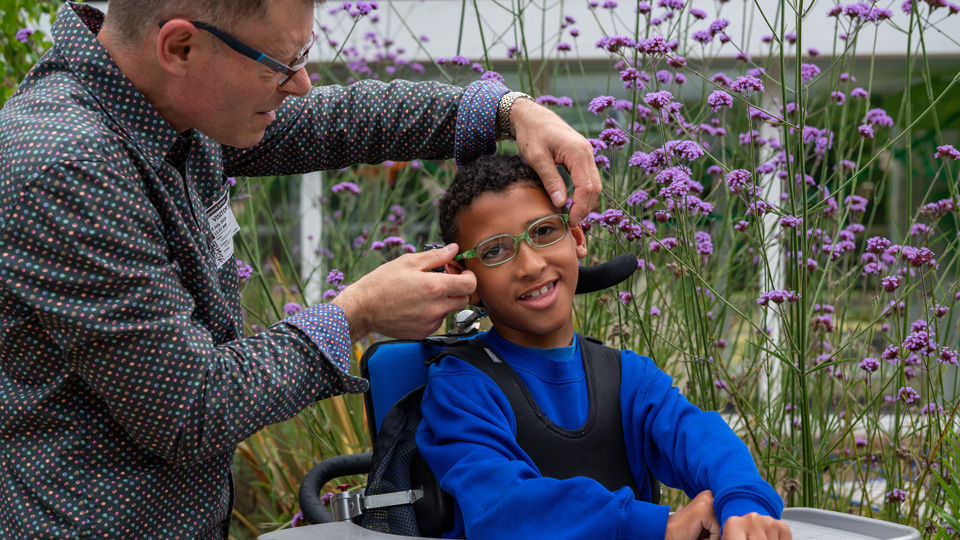
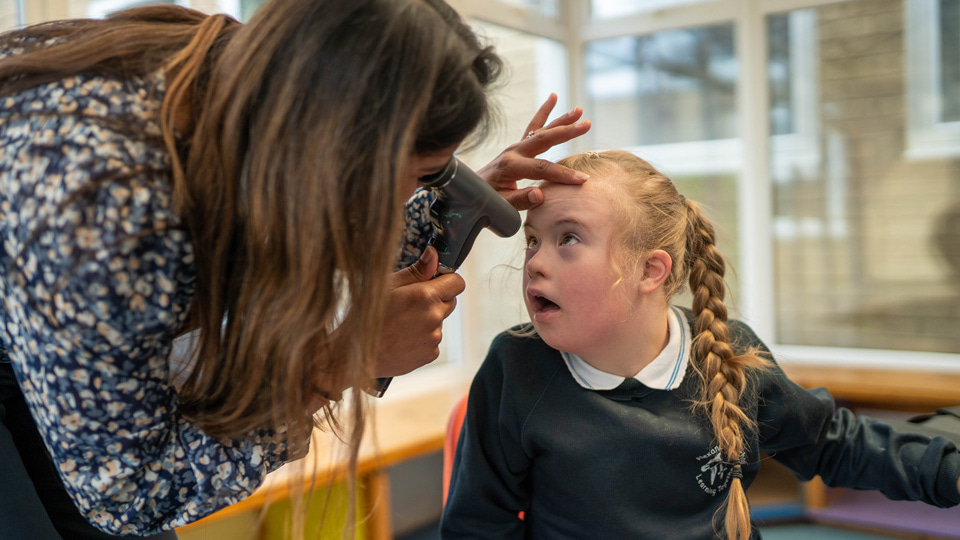
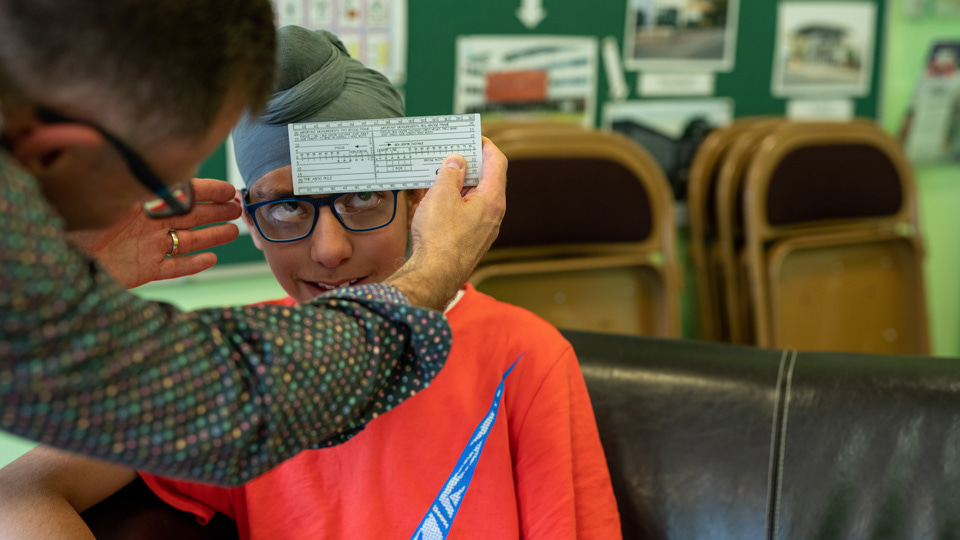
No two days are the same, and no two children are the same.
I’ve carried out eye examinations on the floor, on a table and even inside a sensory tent. Some of the children we work with can become overwhelmed by too much stimulation, so you have to adapt the environment around them. You also have to make the eye examination into a game because otherwise they simply aren’t going to engage. One of the most rewarding parts of the job for me is that I’m able to actually make a difference where previously the child would have struggled to get any kind of eye care.
We see children who have sometimes struggled to access eye care throughout their lives. Some have very significant prescriptions, and initially it can be extremely difficult to examine them. You might know that something is going on but have to work gradually towards obtaining a prescription. Sometimes the first prescription won’t be perfect, but getting the child into glasses is an important starting point.
Then you get that moment when they put the glasses on and you see their reaction. It is incredibly rewarding.
Visiting the schools regularly, we become part of the school community. We work as part of a wider multi-disciplinary team, liaising with teachers for visual impairment, SaLTs, hospital eye service departments and other healthcare providers for that child to ensure we are doing the best we can for that child, without duplicating care. Hospitals in areas we have been working in for a long time know they can trust us and proactively discharge children to us as they understand the school setting is a much more conducive environment for eye tests for children with learning disabilities and autism.
The children recognise us when we come back. Some of the children we see are non-verbal, but they might point to their glasses when they see you. It is really lovely because you realise that you have become familiar to them and someone they can trust.
I love that I can use my optometry skills in a completely different way. It is challenging, but it is fun and really rewarding.
Delivering eye care in special schools has also stretched and helped me advance my clinical skills. We use a wide range of tests, including preferential-looking techniques, functional vision assessments and routinely attempt dynamic retinoscopy – these things are not regularly used on the High Street.
The training that SeeAbility gives practitioners delivering this eye care is really important. As a result, we has developed a Level 7, 15-credit module with City St George’s, University of London, that provides comprehensive training for optometrists working with children with learning disabilities.
A rewarding role
I would encourage other optometrists and dispensing opticians to consider working for SeeAbilty’s Special schools programme. It can feel daunting, particularly if you have never worked with children with learning disabilities before, but you learn as you go and you have the support around you.
It is also a great job for people with young families because it is a term time role within school hours. That flexibility can make a real difference.
I love that I can use my optometry skills in a completely different way. It is challenging, but it is fun and really rewarding.
One experience that has particularly stayed with me involved a child with profound and multiple learning disabilities. The qualified teacher of vision impairment had always said that the child didn’t really engage or make eye contact. We eventually managed to test the child’s eyes and provide glasses. Later, the school took the children on a trip to a museum, and the teacher told us that, for the first time, she had seen this child actually looking around and engaging with the environment.
Those moments make you realise the difference that good eye care can make.
Terence’s story
About the author

Malvi Patel 
Clinical lead at SeeAbility
Malvi Patel is an optometrist and clinical lead at SeeAbility. She delivers eye care to children through the charity’s special schools programme
More Opinion
-
 Sally Jones: “Someone to listen and just be there can literally be a life saver”
 -
 Richard Spencer: “Optics offered far more opportunities than I had ever imagined”
 -
 Adam Sampson: “There is a time when you have to stand your ground”
 -
 “Optometrists have the expertise, the equipment, and we are in the community”
Comments (1)
You must be logged in to join the discussion. Log in
Anonymous5 weeks ago
That was lovely to watch and very emotional. How very rewarding for all those involved. Would love to get involved in the future.
ReportLike0