
01 November 2025
Like many busy practices, Edmonds & Slatter Opticians faced the challenge of balancing patient care with efficiency. The traditional imaging workflows often required multiple devices, longer appointments, and complex coordination between staff members. Vikesh Chauhan, the lead optometrist, was seeking to further optimise workflow, minimise patient movement between devices, and support confident, time-efficient diagnoses.
Vikesh Chauhan, lead optometrist at Edmonds & Slatter Opticians

Location: Leicester
Device: MonacoPro
Average daily scans: eight
MonacoPro integrates single-capture 200° UWF optomap imaging with spectral-domain optical coherence tomography (SD-OCT) of the macula, enabling comprehensive retinal imaging in one session. It offers five imaging modalities – optomap colour, red/green separation, green autofluorescence, and high-resolution SD-OCT – that can be captured in less than 90 seconds, reducing exam time.
Chauhan has since introduced MonacoPro into the practice’s routine protocols and has already observed tangible improvements in workflow efficiency and patient outcomes.
Ease of use across the team
MonacoPro’s intuitive interface and short learning curve meant that all members of Chauhan’s diverse team, including optometrists, dispensing opticians and optical assistants, could operate the device easily.
It’s a smooth and efficient system. My optical assistants can capture images and scans quickly, my patients appreciate the comfort and speed, and I value the ability to view both macular and peripheral pathology in one quality scan
Today, the device is used across a team of five rotating optometrists, with five dispensing opticians and 14 optical assistants trained to operate the MonacoPro. This flexibility helps manage a busy practice.
Enhanced diagnostic confidence
Published data indicates that MonacoPro can deliver up to a 30% increase in the detection of macular pathology compared to fundus imaging alone1. Chauhan credits the clarity and depth of optomap and SD-OCT images with MonacoPro.
“Due to the sharper image quality of the MonacoPro, enhanced visualisation allows earlier detection and confident management,” he explained.
“Additionally, the high-quality scans eliminate the need for repeat OCTs, which streamlines imaging and improves patient experience.”
Chauhan highlights the case of a patient who presented with exudative age-related macular degeneration (AMD) in one eye and an apparently asymptomatic fellow eye that appeared to have early non-exudative AMD on fundus photography. It was only on reviewing the OCT scans that focal macular oedema was detected in the otherwise dry-appearing fellow eye.
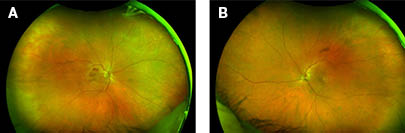
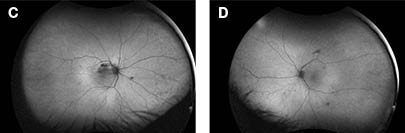
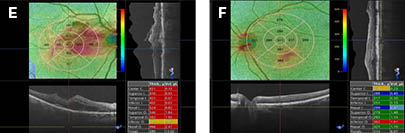
Multi modal retinal examination using the MonacoPro: A 74-year-old female presented with reduced vision when reading. Ultra widefield (UWF) colour imaging showed haemorrhages and oedema in the macula of the right eye (Figure A) and macular drusen with retinal pigment epithelium (RPE) alterations in the left eye (Figure B). UWF fundus autofluorescence showed hypo-autofluorescent areas corresponding to retinal haemorrhage in the right eye (Figure C) and mid-peripheral hypo-autofluorescent spots corresponding to RPE alterations in the left eye (Figure D). On spectral-domain optical coherence tomography (SD-OCT), the right eye (Figure E) showed increased macular thickness due to the presence of intraretinal and subretinal fluid, which was associated with disruption of the retinal layers; the left eye (Figure F) showed bumps in the RPE, suggestive of drusen, and increased macular thickness in the outer inferior sector of the retinal thickness map, revealing macular oedema that was not apparent on colour fundus images.
A formidable toolkit
MonacoPro OCT includes automatic analysis of retina, ganglion cell, retinal nerve fibre layer (RNFL) and optic nerve head detail, and is complemented by a comprehensive reference database that further enhances diagnostic capabilities2.
“If we’re unsure about something, it’s easy to pull up comparison images,” Chauhan noted. The database also helps onboard new staff with accessible reference materials.
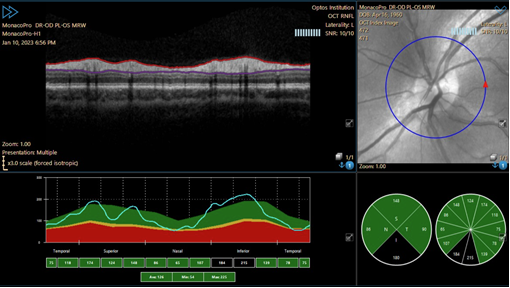
Retinal nerve fiber layer (RNFL) SD-OCT scans centred on the optic disc obtained by the MonacoPro. *Details may vary depending on region
Chauhan added that the Optos support team has been instrumental in training the staff in the use of other cutting-edge tools included in MonacoPro, like the AreaAssist feature, which allows users to automatically measure continuous areas of matching colour. This avoids laborious manual analysis, freeing up time that can be devoted to patient care.
The ultimate goal: workflow transformation
According to Chauhan, MonacoPro has transformed how Edmonds & Slatter approaches retinal imaging, delivering the efficiency and clinical excellence he sought.
“The practices now perform roughly eight exams per day using MonacoPro. The more consistent use of SD-OCT in routine evaluations has really improved our diagnostic accuracy, while still achieving faster workflow and greater patient throughput,” he said.
By combining clinical precision and operational simplicity, MonacoPro has enabled the practice to enhance patient care with the latest technology whilst optimising workflow, a vital balance in today’s healthcare environment. The device’s adaptability across different staff roles, combined with its comprehensive diagnostic capabilities, positions the practice for growth and strong outcomes.
References
- Aiello et al. Integrating Macular Optical Coherence Tomography with Ultrawide Field Imaging in a Diabetic Retinopathy Telemedicine Program Using a Single Device. Retina. 2023
- Salazar et al. Optical Coherence Tomography Measurement Correlations with Age and Optic Disc Size. Investigative Ophthalmology & Visual Science. 2024.