

Kevin Hewish
23 January 2025
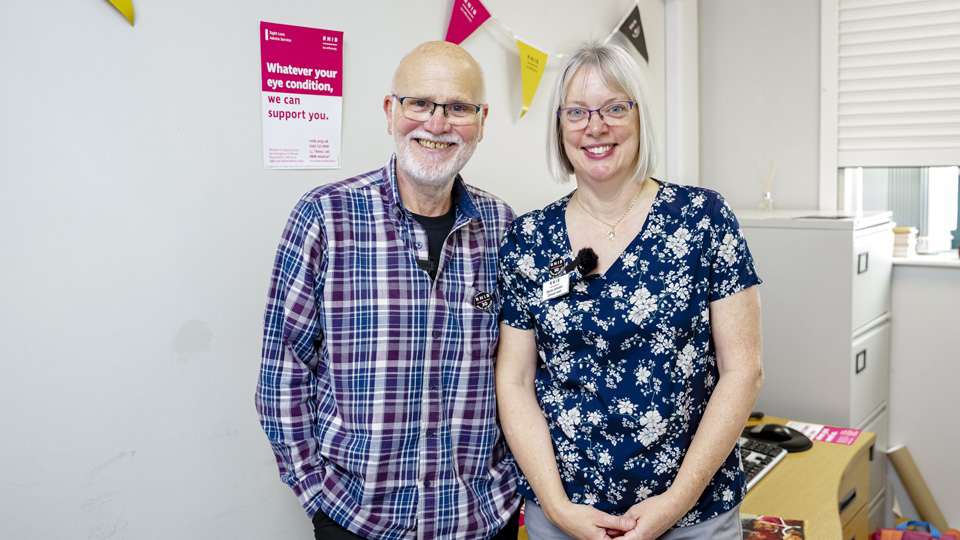
I worked as an Eye Clinic Liaison Officer (ECLO) for four and a half years, and then I took on a management job with the Royal National Institute of Blind People (RNIB), which I did for a further two and a half years.
That management role included managing the ECLOs. There was only a small bunch of us – maybe five or six at that time. Then I came away from RNIB, and finished my qualifications as a psychotherapist, and that’s what I’ve been doing ever since.
We had just moved to Rotherham, as they were setting up the ECLO contract. I had no background in visual impairment. I’d worked with people who had physical disabilities, and I had health experience as a psychiatric nurse, and social care experience, so I went along with that.
At the ECLO interview, I got completely fired up, because the two guys who were interviewing me were very enthusiastic. They pointed out that this was quite groundbreaking, and that it was a brand new service, and therefore something that I could have a big part in shaping.
I was in my early 30s, with a reasonable amount of experience behind me. I recognise now that I was still a little bit wet behind the ears, but I thought I knew it all, and I was ready to be this innovative person. As soon as I got into clinic, even though there were challenges, I knew that it was something I would enjoy and that I could give lots to and get lots out of.
Some people were very resistant to the role. There were some toes stepped on as we were setting up. I was going under the banner of championing the service user, and being told quite clearly: who are you to speak for the resident medical staff?
As the years went on, though, that animosity went, and people saw that I was serious, that RNIB was serious about this role, and that we were here to stay and to do a good job for the service users who we were all supporting. We were all on the same side.
I had great help from the nursing staff and a couple of the doctors. The orthoptic department was next door to my office, and they were very supportive and had a good idea about what we were trying to do. When I started meeting clients, I learned lots from them too.
It was a brand new service, and therefore something that I could have a big part in shaping
The revolutionary act of working together
In the mid 1990s, there were a lot of contracted funds available for the first time. The funders liked services that moved between different areas. The fact that we were based in health, but a lot of our referrals were going to social services, and we were working very closely with social services and the voluntary sector – they liked that, and so there was funding available that my managers were tapping into.
It was also about recognising that that hadn’t happened very much before. Previously, I worked in either health or social services and a little in the voluntary sector, and never the twain would meet. Here, we were insisting, from the service users’ point of view, that we needed to work together. That was the bit that was revolutionary.
Developing a patient-centred service
I was a relatively young man then, but I had 12 years’ experience in health and social care up to that point, and I had always worked in roles where patients had been fitted into the service.
But what we were saying was, ‘here is the service user, and we build a service around them.’ We were putting them right at the centre. That was a big innovation, as far as I was concerned. Working with health professionals, working with rehab officers, working with the local voluntary sector – it felt new and edgy, saying that we needed to take this from the service users’ point of view.
Over the years, I’ve stayed fairly close. I’ve kept in contact with various ECLOs and the people who are currently managing the service for RNIB. I recognise that that is something that has been taken forward in the training of ECLOs. In getting people on board, it’s all been service user-based.
Now, in the 2020s, I recognise that a lot of services do that. That is much more common now, but I don't think it’s universal. There are still some health and social services that are still service-based rather than user-based. I currently work within the hospice system, and I think we do still have some way to go. Sometimes health and social services are still not the best bedfellows.
A lot of people who go into services don’t know what they can say and what they can take control of. In the eye clinic we would say, ‘these are the things that are available, but you have a say in how they work and which you want to access, and when you want to access them.’
A changing landscape for service users
The formalisation of recognising that somebody has a visual impairment has changed quite considerably. I understand that the ECLOs are still very much involved with that process and explaining it and being a point of contact, which we also did back then.
But the processes have changed, and I think that the services that are available are different. We did a lot around welfare benefits. That’s now different, and areas have different support systems around that sort of thing, so that might vary between one clinic and another.
But it’s about getting to know the local services, and that hasn’t changed. I had to do that 30 years ago, because there wasn’t a central point where you could go and say, ‘what might be available for this person who is looking for this service or this welfare benefit?’ I became that person. I had to find out.
Now, that sort of thing is more widely available, because the role has become much more commonplace. Now, all the major eye clinics throughout the country are covered by an ECLO. That’s going some from where we were when I was the first, and Stella down in Winchester was the second.
The current Rotherham ECLO said that she gets people referred to her much earlier these days than when I was in post. To have somebody referred early means she can have a chat with them about what they might need in the future, and let them know that, if their eye condition gets worse, they don’t need to worry, because there are things that can be put in place that might be helpful.
Relationship with optometry
We worked quite closely with optometry. Optometry was done by two of the registrars, and when they started to see somebody’s sight significantly deteriorating, they would often make a referral. We also had a low vision clinic, which was run by an orthoptist, and she would refer to us too.
We also got in contact with community optometrists in Rotherham. We put together an information pack as part of a local launch, and sent out copies to all the local optometrists explaining our service and that the information might be useful for some of their patients. I can certainly remember one of the local optometrists, who referred several times. That was a good connection to have.
Often, optometrists are the first people who see significant sight loss in their patients. I understand that they are much more likely to refer directly to ECLOs now than they were back in those days, because we were only just getting ourselves known. Now, the service is well known.
One of the consultants who I worked with then is still working part-time, although he’s partly retired. He was saying that, at ophthalmology conferences, he was always talking about ECLOs, and that he’s so impressed to see it being so much more widely spread, and how useful it had been over the years.
We can’t all be everything to everybody. We need to work together
Having somebody with a different skill set and a different approach within clinic is really useful. I can see that in my current work, and work that I’ve been in along the way. We can’t all be everything to everybody. We need to work together, and a service that helps with that, that helps the communication or helps the keeping the client at the centre of that, is going to be useful.
I feel incredibly proud of what we did back then, and the fact that there now ECLOs in all the major eye clinics throughout the country, and that there is professional training available. That there is good coordination in the work between national local organisations, and health and social services, is brilliant.
- As told to Lucy Miller


Comments (1)
You must be logged in to join the discussion. Log in
Iain Mellis28 January 2025
The work the ECLOs do is wonderful. I have a great respect and immense appreciation for the time and effort they put in to make patients at ease.
It was great to be able to read a bit about the history of the first ECLO and would love to maybe see him present a CPD on his time working as an ECLO.
ReportLike50