


31 December 2024
Journalists, politicians and musicians were amongst the familiar faces joining the Royal National Institute of Blind People (RNIB) at a celebration of 200 years of braille in November.
The evening, which took place at the British Library, celebrated two centuries since Louis Braille’s configuration of six raised dots first revolutionised the ability of blind people to communicate.
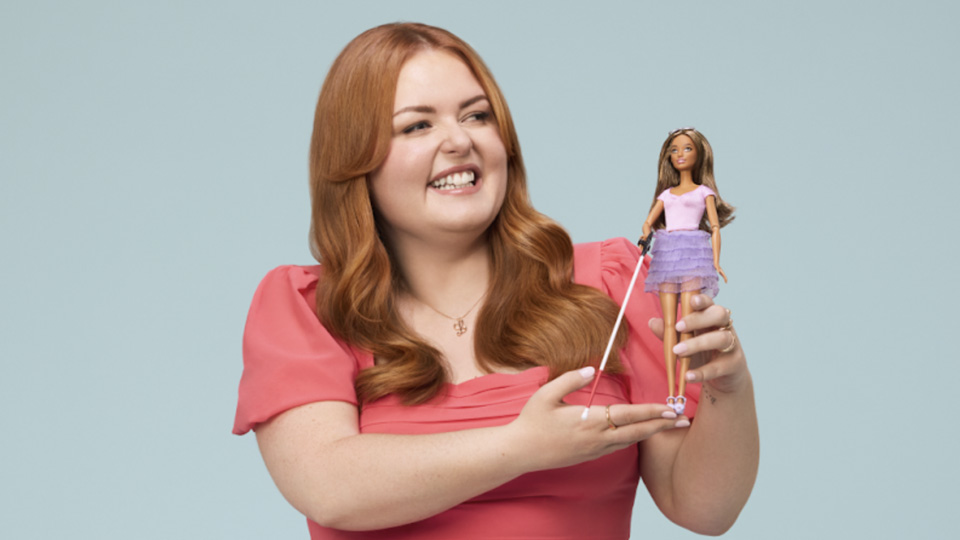
Lucy Edwards, disability activist, journalist, and now the face of blind Barbie, joined TikTok content creator, Seren Jaye, and opera student, Toben Durrant, in sharing her experiences of braille with OT.
How long have you lived with your condition?
Seren Jaye (SJ): I started losing my sight in January 2021. I’d had perfect vision before then, and it just started going gradually. I was studying photography at college, and I started to notice that I couldn’t see the viewfinder to see if it was focused anymore.
I’ve been slowly losing more central vision, but it’s got quite stable now, and I’m learning to use my peripheral vision a lot more.
I still don’t have a diagnosis. I’ve got some fluid build-up on my retina and some of my optic nerves are damaged. But they can’t find a cause, so I don’t have a diagnosis, which is obviously something that I need to explain to a lot of people. That affects me in everyday life much more than I thought I would.
I have Tourette’s syndrome as well, which is totally unrelated to my sight loss. I started making videos about that in October 2020, and then started losing my vision quite soon after that.
It took me about a year to get used to it, and to start talking about my sight loss. I didn’t talk about it at all online at first. But after a while, I started making more videos, and found that, actually, it was something people were really interested in.
When did you start using braille?
Toben Durrant (TB): I started learning braille in about year five, and thought, ‘I’ll never use this, I have enough vision to get me through.’ But my specialist teacher said, in a very delicate way, ‘no, you’re switching to braille.’
That was a brilliant decision by her. Otherwise, I would’ve sat in my GCSEs and A-levels, confused, and would not have done as well as I did.
SJ: I haven’t been learning braille for long. I had my first lessons in January 2022, but I’ve recently picked it back up again for my Queen’s Guide award, for the ‘developing a personal skill’ requirement.
It took me about a year to get used to it, and to start talking about my sight loss. I didn’t talk about it at all online at first
What is your relationship with braille now?
TB: It has helped me in my education. I’m still studying, so it continues to help me with my degree in vocal studies (opera). I’m currently in my first year. It helps when I’m reading music, and with language and word learning. Doing it orally, you can get so far, and then you hit a wall. But with braille, you can get a bit further.
In terms of accessibility with my university course, there were a few hitches to start with, which I expected. It’s new for the course I’m on, and they have tried their hardest. The teachers’ efforts, combined with the librarians’ efforts, mean we’ve managed to get a smooth process. The teamwork is good. Everyone is on the same page.
Prior to university, it was harder. Teachers are amazing, but I imagine braille on top of teaching, for some, can be one step too far.
SJ: One of the reasons braille is so important, especially in schools, is that every child has a different learning style. Personally, I’m not very good at taking in audio, so being able to have something written down that I can refer back to is just how my brain works.
I felt it was important to learn braille because, for example in university, I couldn’t revise for my exams by just listening. That’s just not how my brain works. I wish I had learnt it a bit earlier, but obviously I lost my sight a year before I went, so I couldn’t. It would have definitely helped a lot.
Lucy Edwards (LE): It is so important. I read braille every single day of my life.
When I lost my eyesight, I was like, ‘no, I’m not blind. I’m never going to read braille.’ But I’m so glad that I did do braille lessons as a young girl, because I was like a sponge back then.
When I lost my eyesight a bit more, braille was a thing to be celebrated in my mind. It opened up a world of journalism, and the ability to read scripts back to myself.
I’m not the quickest reader, because I’m not blind from birth. But I use it every day, and I love it. I love my braille display. I love that you can connect it to your iPhone. I love this celebration.
What does being at the RNIB’s Braille 200 event mean to you?
TB: It’s a really good event, where braille users can find out what’s going on in the world and see new products. There are braille Lego bricks out there. It’s interesting, because when I was a kid there wasn’t much in terms of accessible products.
SJ: I think it’s amazing. It’s so important to me. I’m so passionate about it.
It’s been amazing to come across lots of new technology tonight. Some of the new products out there are crazy. There’s a tablet, where you can draw anything on the screen, and then it pops up in little braille pins. It’s so cool.
But I think the best thing is being able to talk to other people who know braille. The networking opportunity is amazing.
TB: I hope people leave this event with the knowledge that braille is still fresh, and is still evolving. It is a vibrant and flourishing thing, that should be encouraged.


Comments (0)
You must be logged in to join the discussion. Log in