

05 December 2025
Two months into my pre-reg placement, my first tasks after I arrive at the practice in the morning are to help everyone to set up, and to discuss the day ahead.
I set up my room, making sure it is clean and that I have all the equipment for the day out and ready.
I will then look at the day ahead and see what patients and appointments I have coming up. This means I can ask questions about any appointments that look like they may be challenging. This may be a sight-impaired patient, or someone with a risk of glaucoma.
I work through the day, which is usually busy, taking time after every appointment to update my logbook and ensure everything is signed.
Since I started my pre-reg placement, the number of eye examinations I can complete in a day has gradually increased. My testing time has decreased, and the days have become much busier. It has become easier now that I have a more established routine.
I feel that the location I chose has both pros and cons.
Before I started my pre-reg placement, I wasn’t aware of the huge difference in shared care schemes and between the enhanced appointments we could and could not perform in different areas. For example, the area I am in does not provide a Minor Eye Conditions Service or NHS supplementary eye examinations, which does mean I do a larger volume of full sight tests and have less exposure to acute conditions such conjunctivitis.
Before my pre-reg started, I wasn’t aware of the huge difference in shared care schemes and differences in enhanced appointments we could and could not perform in different areas
My biggest learning so far is how many patients are asymptomatic.
As we mainly do full sight tests, it is very important to be vigilant in all areas, such as ophthalmoscopy, as I have found more peripheral retinal pathologies such as small tears and holes that patients weren’t aware of – but that had to be treated with urgency by our local eye infirmary.
One challenge I have overcome is developing a routine where I can complete all the studying that I need to be doing.
Every day is busy, so there often isn’t time to complete learning modules and extra studying until I am home in the evening.
Despite this, I like to try and ensure that I am using quiet times in practice to study, when findings are fresh in my mind – for example, researching medications I’m not familiar with, or asking my peers about optomap scans, optical coherence tomography, and other records. I also make sure I stay consistent, doing little and often at home on days off and after work.
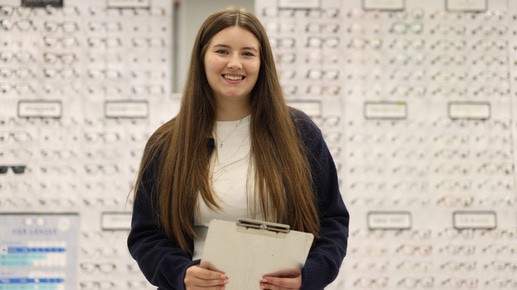
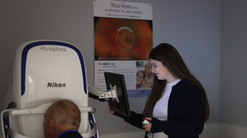
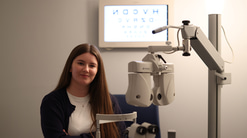
One interesting example of pathology that I have seen was a woman complaining of headaches, with swollen discs that did not present as they typically would.
I made sure to discuss with my supervisor, as it looked as if it could be optic disc drusen or swelling.
I also recently saw a patient with Sjogren’s syndrome for the first time, and was shown a scan of a patient who had undergone plaque radiotherapy for ocular melanoma, both of which were very interesting.
I recently saw a patient with Sjogren’s syndrome for the first time, and was also shown a scan of a patient who had undergone plaque radiotherapy for ocular melanoma
I also saw a patient with very high blood pressure, who had raised discs.
It was daunting at first, however, my supervisor guided me through the referral to ensure it was sent quickly so that the patient could be managed with a reduced risk of any sight loss or vascular event.
I tried to stay calm and explained to the patient that my supervisor was going to help me check the nerve in the back of the eye, as it appeared to be affected by their blood pressure. The patient was happy to ask questions and have this checked, as they were suffering painful headaches and other symptoms due to their high blood pressure. After the test and referral, I was relieved that we were able to help them.
The most important thing I have learnt in the past 60 days is to stay calm.
As a pre-reg, your supervisor is there to help you and to answer ask any questions that you need to ask. Often, once you have seen a similar case before you can apply that knowledge the next time.

Nora Amoakohene is pre-reg optometrist at Premier Vision in Bradford. Watch her second video online now.
About the author

Eliza Jane McCall 
Optometrist
Eliza Jane McCall is a newly qualified optometrist at Boots Opticians in Sunderland


Comments (0)
You must be logged in to join the discussion. Log in