


07 August 2026
Since 2021, an innovative clinic at Cardiff University has been bridging the gap between the theoretical knowledge afforded to higher certificate students, and the real-world skills that are needed at the top levels of optometry practice.
At the same time, Cardiff’s Teach and Treat clinics have been successful in cutting the waiting lists for conditions including age-related macular degeneration (AMD).
Here, Cardiff optometry school’s Matthew Chan and Jeenal Shah tell OT about the advent of the clinics, and why they have proved such an invaluable resource.
Can you tell OT about how the Teach and Treat clinics began?
Matthew Chan (MC): Teach and Treat clinics were launched as a collaboration with University Hospital Wales (UWH) and Cardiff and Vale Health Board, to help with the backlog of patients. Alongside that, there was the educational component, for optometrists who needed to upskill with higher qualifications.
Our experts
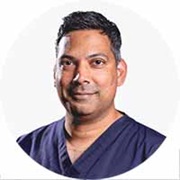
Name:Jeenal Shah
Occupation:Optometrist at Bristol Eye Hospital and senior lecturer at Cardiff University

Name:Matthew Chan
Occupation:Optometrist and senior lecturer at Cardiff University
The original clinic was a glaucoma clinic, which my colleague Angela Whittaker set up. Then, myself and Jeenal formed the medical retina teaching clinic. When we began, it was quite archaic: they were using fax-based referral systems. Patients were sometimes waiting months for their first anti-VEGF injection, when the national guidance is two weeks from referral to treatment.
We had students coming through who were doing the higher certificate in medical retina qualification, which mandates students to see 200 patients. Initially, it was a triage and referral refinement service: optometrists would suspect that the patient had wet AMD, and we would be the go-between.
Things quickly developed, when we realised how significant the backlog was. We were triaging through the pending list, and then it developed into us seeing more cases that had been referred a significant amount of time previously.
The clinic is quite comprehensive in terms of the teaching, alongside helping the hospital with the backlog. The clinic has won quite a few awards, and the model has been replicated in other health boards in Wales, including in Swansea and North Wales.
How do the Teach and Treat clinics work?
MC: When we first started, our audit saw that 70% of the patients referred into us were either discharged or monitored. That 70% is based on when we were the only referral refinement centre, so all the patients would come to us, but the vast majority we would discharge or monitor. That further highlighted that there was work to be done to give optometrists in the community more confidence. Some of those optometrists have now come through our clinic, and we like to think that they’ve got more experience.
We have, like any other clinic, a list of patients to see. The higher certificate students come in, see the patients themselves individually to examine them, take histories, and look at the diagnostic imaging. They’ll come up with a provisional plan, then they’ll come to one of us, and we’ll work through it together, like we would in a hospital. We see the patient with them, and over time they get more confident and more experienced.
Alongside that, we have undergraduate students who will come in during term time, to observe the clinics. We also have, in Cardiff, a lot of full-time international Master’s students. They can get experience in different ways: sometimes through direct observation, like the undergraduates, but they will also do some of the jobs in the clinic, like imaging, visions, or preliminary testing.
Also, we do have students who are doing research. They can utilise our clinics to access patients for their research projects. Not only do the clinics provide education for optometrists, we are also involved in research in areas including AMD and hydroxychloroquine toxicity, which is valuable for the long-term.
There is a big range of people working through the clinic, all with different experiences, with everybody learning from each other.
There was work to be done to give optometrists in the community more confidence. Some of those optometrists have now come through our clinic, and we like to think that they’ve got more experience
How did you identify that clinical confidence was an area that needed addressing amongst those taking on higher qualifications?
MC: The feedback you get from students when they transition from the professional certificate to the higher certificate in medical retina is that the gap is significant, as it is with glaucoma. From our experience working in the hospital, and from the Teach and Treat clinics, seeing the type of referrals that you initially get, compared to when they come to the end, is vast.
JS: Normally, these optometrists would have done the professional certificate medical retina course initially, and there’s no clinical placement with that – it is purely theoretical knowledge. However, the WGOS contracts are given out on the proviso that optometrists have already got a professional certificate in medical retina, which may not give them the adequate experience and full knowledge to understand what they don’t know.
When they do a higher certificate, they are exposed to many more medical retina conditions, which they may never have heard of before. It improves their differential diagnosis, and allows them to refer and refine referrals more accurately, with more confidence.
The feedback we get, when they come to our clinics, is that they would not be confident fulfilling this contract, whilst just having the professional certificate. Having this experience has developed their knowledge and confidence in knowing whether something is wet AMD, or something else.
MC: There’s often a presumption with medical retina that it’s very straightforward, and that there are only three main conditions: AMD, diabetic eye disease, and vein occlusions. Generally, it’s binary decision making: you look at a scan, and it either is sight threatening and needs treatment, or it isn’t.
But what makes medical retina so exciting is that it’s so diverse. There are hundreds of different presentations, and it can give a view on the whole body. I think, unless you get that exposure outside of a textbook, it’s very difficult to be able to provide those kinds of services and have the confidence.
JS: We’re also trying to help them with their communication with patients in terms of management and treatments. Also, how they correspond with other medical professionals, such as GPs and consultants. We are guiding them how to write referral letters that include the minimum relevant information. Guiding them on those aspects, I think, is very useful.
What gap do you see the clinics trying to fill – what is the main problem that they are fixing?
MC: The immediate problem was the capacity issues for the hospital, which is a familiar story. By taking some of that pressure off them, it allows them to see patients that genuinely need to be seen there.
The bigger gap, from my point of view, is the training and the clinical exposure for optometrists. You have optometrists who are academically capable – they have the theoretical knowledge, but in terms of clinical experience, they are under-exposed.
Because we have run both the professional certificates and the higher certificates, when we see new optometrists coming through at the hospital, we now see that clinical experience, and that decision-making ability – being able to apply that knowledge into real-life cases. In real life, it’s not textbook – things present differently, and sometimes there are dual pathologies.
The big thing, for me, is teaching them how to manage a patient individually, rather than following an algorithm or a protocol. In an age of artificial intelligence, and accessing education online, people can get that theoretical knowledge, but it’s about that practical exposure, being able to make pragmatic decisions, and one-to-one teaching. That is one of the main benefits.
Jeenal Shah (JS): The optometrists who are coming through our clinics really value the one-to-one tutorship we can give them. For example, if there is an optometrist who has reduced knowledge in a certain aspect, we can tailor their learning needs accordingly, so it’s individualised learning for them.
To deliver the upcoming WGOS contracts, there was a need to upskill the workforce locally. This was helped by Health Education and Improvement Wales funding these courses, but the limiting factor was that, in order to do the course and complete the higher certificate in medical retina, students needed to do a placement.
There was a lack of placements in hospital settings, especially across Wales. There was not an appetite for the hospital to have a lot of these optometrists in one go, sitting in their clinics. A lot of the time, students needed to do their own work-up, and there were not enough rooms in the hospital for them to have their own room, let alone see their own patients. Utilising our Teach and Treat clinics was very valuable: they all had a room, they could see the patients themselves in their own time, work them up, and we would provide them with advice and guidance throughout the process.
The optometrists who are coming through our clinics really value the one-to-one tutorship we can give them
How do you work with the health boards on the Teach and Treat clinics?
MC: When we first started, it was quite innovative in terms of the collaboration. The health boards would help us with the infrastructure, including sharing of medical records and being able to view images. In medical retina, imaging is very important, so they would be able to see what imaging we do locally, and we could see theirs. There was clinical oversight, but the priority was the access to the patients, and seeing the mutual benefits that could be had.
Now, it’s slightly different, because the new pathways have come into play. We still have a very good relationship with the health boards, and we are one of the providers for the WGOS pathways. Because of our experience and the service we can provide, we will see the more complex patients.
JS: Cardiff and Vale is our local health board, and secondary care and primary care are within the same health board. Initially, our link was with secondary care, via UHW. We had a good collaboration, which enabled us to work together to get the patients seen in our clinic first as a direct referral, and then we would pass that patient on to the hospital for further treatment or investigation, if needed. Otherwise, we would continue to see them in our own clinic for monitoring, or we might discharge them back to their primary care optometrist.
Now, with the WGOS contracts in play, we are primarily working with primary care services in that health board, so that we can deliver the contracts.
Did the reform to the Wales optometry contract in 2023 have any other impact on the clinics?
JS: WGOS for medical retina had delayed implementation, with medical retina filtering and medical retina monitoring deferred into 2025. Up until then, we were still in collaboration with UHW, and we were seeing their patients.
Since implementation of WGOS for medical retina, an optometrist only has to have a professional certificate in medical retina to provide the service, which means there are approximately 30 providers across Cardiff and Vale that can now do the retina filtering.
That did reduce the number of patients coming in to our Teach and Treat clinic, which probably had a negative impact for our students, who needed exposure to cases. This was helped by us still seeing patients with UHW. They had a pending list of routine referrals, and we were able to see those separately, which gave a really good case mix for our students to learn from.
What has been the most significant impact of the clinics?
MC: For me, helping the local population. I'm quite proud of that. There's so much we can do, but we have brought the waiting time down.
JS: It was about 14 or 15 weeks for the first injection, and we brought it down to about four weeks.
MC: We were seeing a lot of people who were losing their sight, so we’ve made a big impact locally. Also, it is rewarding that we really do help these optometrists become a lot better and more confident.
JS: Without the Teach and Treat clinics, I don’t think that a lot of these optometrists would have been able to complete their higher certificate. They would not have got a placement. They’ve gone on and achieved qualifications that they wouldn’t have otherwise. On top of that, whilst achieving the qualification, they’ve had this one-to-one, tailored approach as well.
One of our aims was to upskill the local workforce. I think that is happening, because we are getting local optometrists, who are working in the local area, to come through our clinics.
MC: What is good about the clinic is that it’s in an environment that’s not intimidating. It’s a bridge. When I'm in the clinic at the hospital, higher certificate students won’t really engage much, and they don’t really want to answer questions. At the university, it’s more comfortable.
JS: As an optometrist, going for a week to a hospital, you’re not really going to gain much. If optometrists are coming to us for 200 cases, they’re with us one day a week for six to 12 months. We’re building a nice relationship with that optometrist: we understand them, they understand us, and they can ask us questions. That provides a really useful platform to work from.

“The journey of upskilling optometrists and community practices is not over”
Professor Barbara Ryan discusses relationship building and the importance of peer learning beyond the Teach and Treat clinic


Comments (0)
You must be logged in to join the discussion. Log in