


06 October 2026
There is a “real opportunity” to utilise the skills and knowledge of primary care on the High Street after the proven success of Pharmacy First, health minister Dame Diana Johnson MP told attendees at the AOP’s fringe event during the Labour Party Conference (Monday 28 September, Liverpool Experience Campus).
“We are really using the skills and knowledge of pharmacists, and really developing that, and I think that is absolutely right, because it is accessible,” Johnson said.
She emphasised: “It is on the High Street – people can go; they don’t have to make an appointment. There are real opportunities there to grow that in other parts of their healthcare that is on the High Street.”
Johnson is particularly interested in work around independent prescribing in pharmacies as well as Pharmacy First, she told attendees.
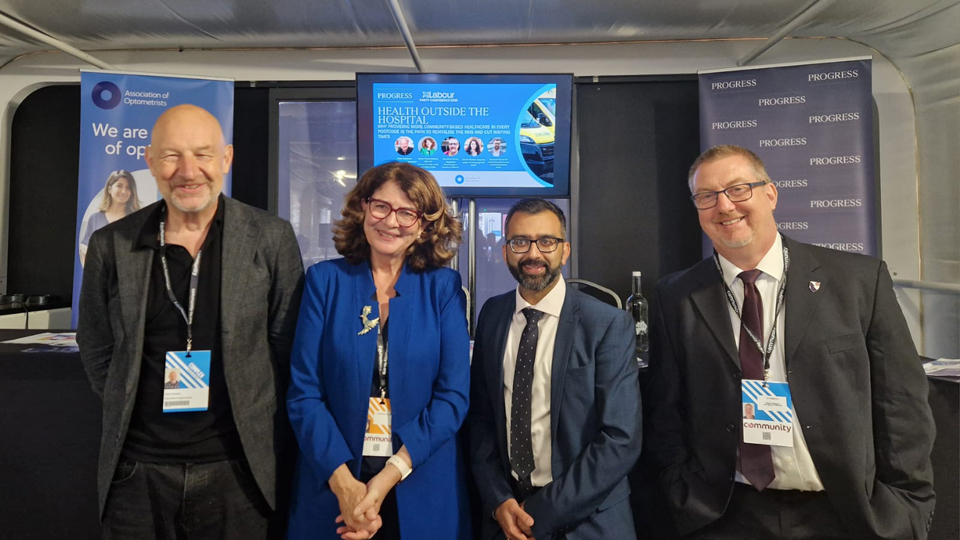
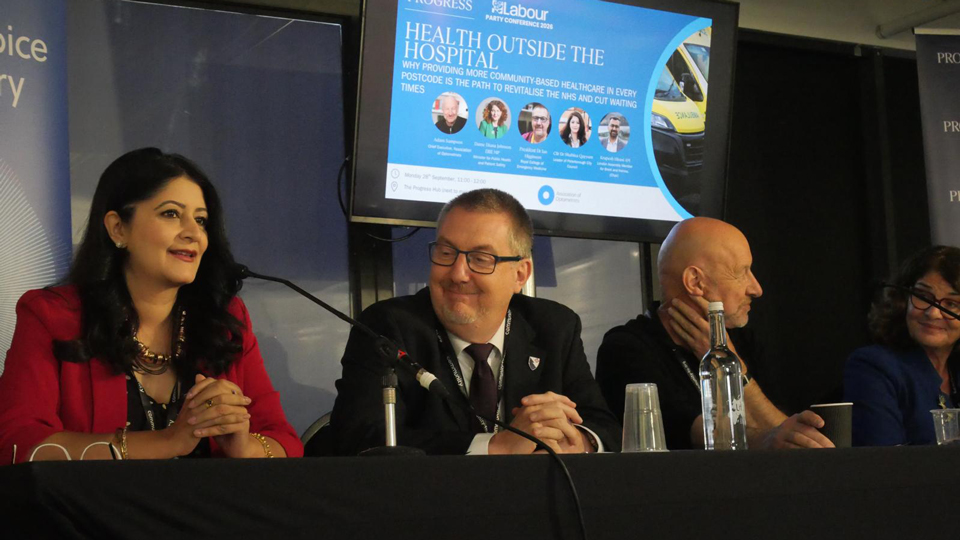
Johnson was speaking as part of the AOP’s fringe event, entitled Health outside the hospital: why providing more community led healthcare in every postcode is the path to revitalise the NHS and cut waiting times.
The panel brought together leaders from emergency medicine, public health and local government to discuss how shifting more care into the community can support the Government’s ambitions for a modern and resilient NHS.
The movement of care from ‘hospital to community’ is one of the three pillars of the Government’s 10-Year Health Plan, alongside ‘treatment to prevention’ and ‘analogue to digital.’
Johnson was speaking alongside chief executive of the AOP, Adam Sampson; president of the Royal College of Emergency Medicine, Dr Ian Higginson; councillor Dr Shabina Qayyum, leader of Peterborough City Council and a practising GP, and Krupesh Hirani, London Assembly Member for Brent and Harrow, on the panel.
Johnson is currently minister for public health and patient safety in the Department of Health and Social Care.
The AOP welcomed her comments, with Sampson emphasising: “Labour has been clear that the future of the NHS lies in neighbourhood care, but that vision will only be achieved if the Government unlocks the full potential of primary eye care.”
“Optometrists already deliver enhanced eye care services in Scotland and Wales, but in England one in four people still do not have access to services that mean their local optometrist can treat common eye care problems. This has to change,” Sampson said.
He added: “We know that over 750,000 people each year in England are going to overstretched A&E departments with eye-related issues. Making sure eye care services are available everywhere would give every community access to timely, specialist clinical care and take pressure off emergency departments and GPs.
“It is vital to make better use of primary care beyond general practice to end the postcode lottery in England. If Labour wants to deliver effective change in the NHS, community optometry must be part of the solution.”
The 10-Year Health Plan and an opportunity for patients needing urgent care
The implementation of the 10-Year Health Plan was a central topic of discussion during the panel event.
Hirani, who was chairing the panel, noted that there is “genuine excitement” from his local integrated care board about the plan’s potential.
The 10-Year Health Plan should highlight good practice across the country whilst not exacerbating the postcode lottery for care, Hirani said.
Sampson emphasised that there is an “urgency on a human level” that is unfolding whilst plans to reform healthcare are being discussed.
Patients are going blind whilst on hospital waiting lists because no community glaucoma services are commissioned in their areas, he said.
In terms of reducing waiting lists, “eye care has some of the answer,” Sampson told attendees.
Sampson said that the examples set by primary eye care in Scotland and Wales, as well as the success of Pharmacy First in England, prove that no more pilots are required to prove the effectiveness of primary care-led services.
England has allowed a postcode lottery that does not exist elsewhere in the UK, he said.
He emphasised: “It is cheaper to do it in the community. What we need is the political will.”
Higginson, who started his career as a GP, noted that he is “a firm believer in healthcare in local communities.”
A large number of patients in emergency medicine are elderly with significant illnesses, and it can often take a long time for them to be seen in this setting, Higginson said.
“Many of the patients do not want to be there,” he said, adding: “We know that patients prefer to be treated in the community.
“Those of us who work in emergency departments are all for treating patients with urgent care problems – not emergencies, because that's what we do, but urgent care, the less severe things – in another setting. Eye problems often meet that category.”
Higginson also emphasised that a large amount of NHS equipment is archaic, with much better technology being found in primary care settings.
He emphasised: “There is an opportunity here for optometrists to contribute to the healthcare picture.
“I think when you’ve got highly trained and highly skilled professionals who are standing up and saying ‘we could do more,’ it would be a shame to miss that opportunity for everybody concerned.”
Utilising primary eye care will not solve problems in emergency departments, Higginson said – but it could improve care for patients.
He also emphasised that, whilst A&E departments are open all the time, optometry practices are not – and that “if services are in the community, they need to be open when patients need them.”
Plans would need to be carefully thought through if urgent care was to move to the community setting, Higginson believes.
Neighbourhood health also means getting back to “the real basics” in terms of delivering the care that is needed closer to people’s homes, Higginson believes.
He explained that, when he was a GP, he took on responsibility for the care of patients within a residential home so elderly residents could avoid unnecessary visits to A&E.
The support that ophthalmologists can give optometrists, including through providing thoughts on scans and imagery, should be improved in order to support the 10-Year Health Plan’s pillar of analogue to digital, Higginson believes.
Sampson emphasised that “consistency and simplicity” in services is what is required, and is why Pharmacy First has been a success.
An opportunity for the prevention agenda
Qayyum told attendees that, whilst leader of Peterborough City Council, she still practises one day per week as a GP so that she can continue to understand how services are working.
Referencing the announcement on social care reforms, made by Prime Minister Andy Burnham on Sunday 27 September, Qayyum emphasised that: “we can’t fix social care without primary care.”
Prevention, one of the three pillars of the 10-Year Health Plan, is vital when it comes to social care, she said.
Good prevention will need a strong economy and reduction in dependency on the healthcare system, keeping patients fitter and healthier in their homes, she believes.
Qayyum used the examples of community glaucoma clinics and optometry practices providing diabetic eye screenings as clear examples of prevention at work.
“The journey needs to follow the patient,” Qayyum said.
Johnson emphasised that she would like to see delivery of the 10-Year Health Plan “now, next week, and next year – not just in 10 years’ time.”
She used the example of a service in her Hull constituency that provides wraparound care for elderly patients as a demonstration of good practice.
It is “a mystery” why this good practice is not spread more widely and enabling this will be a focus for her in her role, Johnson said.
Whilst not everything can be done at the same time, Johnson noted that the Government has increased investment in the NHS, that waiting lists are coming down, and that online systems have improved satisfaction with the NHS amongst her constituents.
All parts of the healthcare system need to be embedded within the neighbourhood health agenda and the Department of Health and Social Care must work with the departments for education, planning and housing, Johnson said.
The second wave of neighbourhood health centres will be coming soon, she added.
As part of the Eye care everywhere campaign, the AOP will continue to work with policymakers, clinicians and local leaders to ensure patients receive the right care in the right place, supporting Labour’s shift towards accessible neighbourhood health provision.
OT has asked the Department of Health and Social Care for timelines on when the next wave of neighbourhood health centres is expected to open.


Comments (0)
You must be logged in to join the discussion. Log in