


18 June 2026
Innovation in primary care, the role of the voluntary sector, and the importance of decisions being made on the frontline of healthcare were discussed when NHS leaders gathered for NHS Confed Expo 2026 (10–11 June, Manchester Central Convention Centre).
A year on from the publication of the 10-Year Health Plan, which set out the Government’s desire to build an NHS that starts in communities and offers care as close to home as possible, conversations at NHS Confed Expo focused on how the currently tentative ‘left shift’ can become a reality.
Here, OT identifies seven key topics from 48 hours of expert panels, primary care discussions, and chats with key partners in healthcare.
1 An “overwhelming” amount of innovation is taking place in primary eye care
Becky Baird, senior fellow in health policy at the King’s Fund, is six months into co-leading a two-and-a-half-year project in partnership with Roche, looking at innovations that can help shift care close to home.
The aim of the project is to identify what the existing landscape looks like for innovations in primary care, and how those innovations will enable the shift of care into communities, Baird told OT.
“What we’ve been surprised about is the sheer amount of innovation happening in community settings,” Baird said.
“We tend to think of innovation as being around hospitals, so we’ve been overwhelmed by hearing about innovations from every aspect of treatment, from systemic anti-cancer therapies to ophthalmology, through to respiratory care,” she shared.
Baird noted that eye care is “a really interesting area, where there’s a lot of work, because so much of the work can be delivered in primary community settings – certainly things like retinal screening.”
She explained: “We’re hearing of loads of really interesting innovations around urgent care. In eye care, we’re looking at different models that allow treatment to be given close to home.”
With primary eye care being dominated by the private sector, Baird explained that there is a learning curve for the King’s Fund in how differently commissioning operates in this space when compared to the NHS.
“We’re also learning about the really important role of industry in driving a lot of this innovation, which has been fascinating to us,” Baird said.
“What we’re starting to try and get a picture of is: where can we go and look that will help us understand even more about how we make innovation happen at scale in primary and community care settings?”
The partnership is looking at sites across the country to understand what is happening on the ground, before distilling what lessons can be learnt by policymakers, Baird said.

“Fighting the good fight” to influence system change for optometry
Lisa Gibson, clinical director at PES, was joined by pharmacy colleagues to discuss influencing change at NHS Confed Expo
2 Optometry must look at the bigger healthcare picture
In the primary care neighbourhood of the future, optometry will need to look beyond its own horizons, Primary Eyecare Services’ clinical director, Lisa Gibson, believes.
Gibson was responding to an audience question on what she believes the ‘primary care neighbourhood of the future’ will look like, as part of the Shaping systems from the edges panel.
“In five years, I really hope that we have patients being seen in the best place, by the best professional, at the right time, within their neighbourhoods. That is the ask,” Gibson said.
She added: “From an optometry point of view, we need to be using our skilled workforce to deliver the aspects of these services that we can.
“We need to look at opportunities outside the standard, such as: how does optometry benefit the frailty pathway? How do we look at hypertensive case findings?”
Gibson emphasised: “In five years’ time, I really hope, for our patients, that we have this more joined up, integrated care model.”
3 The Government’s plans for healthcare live or die in local communities
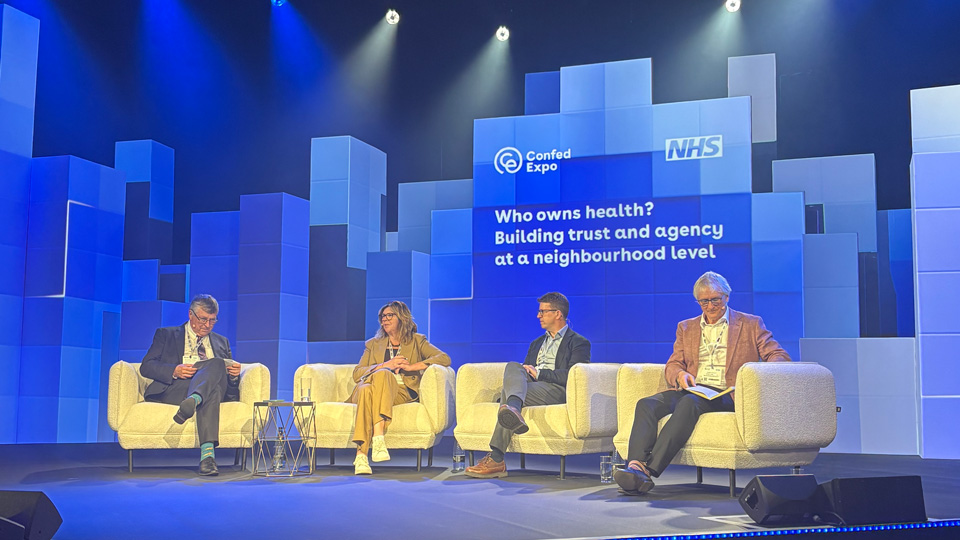
Dr Clare Fuller, national priority programme director for neighbourhood health at NHS England, spoke as part of the Who owns health? Building trust and agency at a neighbourhood level panel during NHS Confed Expo.
Fuller emphasised that the 10-Year Health Plan “is all about neighbourhoods.”
“Neighbourhood health is about joining up both health and care and making it work for people and making sure that the care that people receive is right for them in the right place,” Fuller told attendees.
“We have a 10-Year Health Plan, which came out a year ago, and I would say the central policy in that was that everything is all about neighbourhoods.”
Fuller used an example of a community health centre in Leeds, which housed primary care services including a pharmacist, as well as a GP that served 30,000 people.
Antenatal services and a library were also available in the building, Fuller shared.
She said: “You look at it and think: that is neighbourhood health. That is a neighbourhood health centre.”
Fuller also spoke about visiting a neighbourhood health centre in a deprived part of Derbyshire, Barrow Hill, where a former GP and trustee of the centre told her that he had learnt more about what makes people ill than he had in 30 years in his practice.
“If neighbourhood health is about anything, it is about helping communities like Barrow Hill,” Fuller said.
4 The voluntary sector can facilitate “change at scale”
Also speaking on the Who owns health? Building trust and agency at a neighbourhood level panel, Matt Hyde OBE, chief executive of the Lloyds Bank Foundation, noted that the voluntary sector has the ability to foster “change at scale.”
Hyperlocal organisations can give personalised care and can get “into the nooks and crannies” of what areas need in terms of health, Hyde believes.
He noted that we are in the correct moment to challenge that notion that the voluntary sector cannot facilitate a high level of change.
However, he emphasised that services do need to be funded, and that relying on the voluntary sector cannot be an excuse to implement austerity in other areas, as happened in the Cameron government under the guise of ‘the big society.’
Hyde emphasised: “Storytelling and narrative really matters. It’s what fires us up when we go to work. It’s what gets us out of bed, whether it’s an understanding about an individual story or framing what a vision for our community and our countries looks like.”
He used the example of the Big Lunch in St Neots, Cambridgeshire, which took place on 5 June.
The Big Lunch is a national event, where local communities come together to host street parties.
“Local leadership has inspired hundreds and hundreds of people in a Cambridgeshire market town, where people were ready to shape the future,” Hyde said.
The challenge is how to translate this to community thinking at a national level, Hyde believes.
The Lloyd Bank Foundation are funding work with Demos and UCL Policy Lab on how to create “a nation of neighbours,” he revealed.
He added: “There is a bit of a view that, if I talk about the voluntary and community sector, it’s a bit blancmange; it’s a bit of a cottage industry. Of course we love it, but it isn’t going to solve things at scale.
“I think now there’s a moment to challenge some of those assumptions, and to think differently about what real community building looks like.”
5 Data is the key to unlocking successful neighbourhood health
Data underpins the business case behind neighbourhood health, attendees heard during the Building effective neighbourhoods: from theory into practice panel.
Host, Ben Hampshire, regional director for the north of England at Optum UK, noted that digital and data infrastructure are essential if the ‘left shift’ is to come to fruition.
Joe Lillington, senior insight manager in population health management at NHS Norfolk and Suffolk Integrated Care Board (ICB), also spoke on the panel.
Part of Lillington’s work considers how digital infrastructure sits in the neighbourhood health model.
In Suffolk, the ICB has commissioned services across a range of areas, including primary care, Lillington said.
“One of the strengths that the ICB has is that it has linked data sets across all of these different areas,” he explained.
He added: “If you’re going to have a neighbourhood health programme, which ultimately tries to connect and have a very patient-focused perspective, you need to have that linkage, to try and generate insights across the pathway.”
The digital tools that his ICB has to support the system in providing insights is his “day-in, day-out” at work, Lillington shared.
He added: “We have a lot of business cases that try and promote neighbourhood health, and try and promote left-shift working.
“If we can really understand our population and the different segments in it, then that really underpins the business cases that we have, and really promotes impact.”
Suffolk is seeing a significant flow of funding away from acute trusts and towards ICBs in support of the left shift, Lillington added.
Laura Fisher, chief nursing information officer at Doncaster and Bassetlaw Trust, believes that “we need to have some joined up thinking.”
“I think we’re seeing that a lot more now,” she said, adding: “We’re in a digital revolution. We’ve all been around the cycles where we feel like we’ve tried this before, and it didn’t work well.
“Now, we really are being enabled quite significantly to be able to think in an aligned way to be able to put our patients at the centre.”
Fisher added: “We need to put the patient at the heart of what we do, and we need to look at areas within the neighbourhood as a specialty, and [at] what they can deliver.”
She also noted that, in order to drive down health inequalities, practitioners must have the tools to be able to interpret the data that they have.
“Build the foundations, so we know what we’re asking people to look at,” she emphasised.
6 Changing patient behaviour towards considering primary care
Patient behaviour change is also essential if the neighbourhood health agenda is to be successful, attendees at the Building effective neighbourhoods: from theory into practice panel heard.
There is a need to “take patients with us, and take them on that education piece,” Hampshire noted.
He emphasised that patients need to take some responsibility for neighbourhood health, and that it cannot all come from practitioners.
Fisher used the example of Pharmacy First, where patients can now access medication for certain conditions from a pharmacist, as something that has caught on amongst patients.
Dr Aravinth Balachandran, clinical director and GP partner in Folkestone Hythe and Rural Primary Care Network, emphasised that patients need to be involved in the left-shift journey from the start.
“From a patient’s perspective, it’s a complicated landscape that they’ve got to navigate at the moment,” Balachandran acknowledged.
“As we redesign these models, we’ve got to involve them and make sure their insights are captured, and that that is adequately communicated,” he said.
Balachandran added: “We will have the engaged and activated patient, but it should be a seamless journey for them to navigate, as we shift into a needs-based focus rather than just a reactive and activity-based focus.”
7 Decisions need to be made on the healthcare frontline
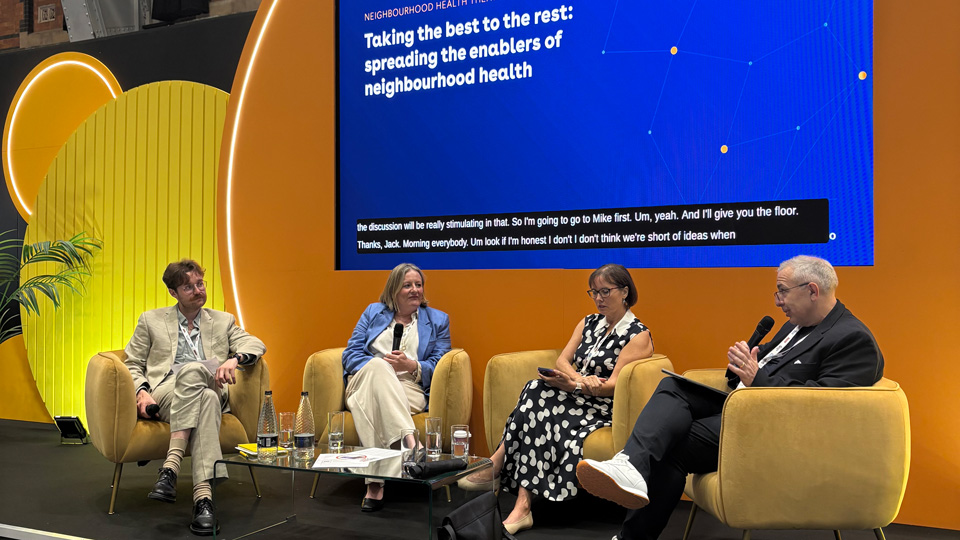
Whilst strategies can be worked up in offices, decisions on neighbourhood health need to be made by practitioners on the frontline, Mike Barker, deputy chief executive at Oldham Council & NHS Greater Manchester, told attendees.
Barker was speaking during the Taking the best to the rest: spreading the enablers of neighbourhood health panel.
He emphasised the importance of “putting enablers to work very deliberately.”
In terms of finance, this means “aligning budgets around neighbourhood priorities, not organisational silos,” Barker believes.
He acknowledged that creating neighbourhood health is difficult, because it “challenges how power, resources, and accountability currently flow through systems.”
Barker added: “If we're serious about spread, then we need to focus, in my view, far less on designing the model and more on creating the conditions where it becomes the easiest for people to get stuff done.”
Dr Penelope Blackwell, GP, chair and clinical director for neighbourhood health and care at Derby and Derbyshire ICB, believes that “neighbourhood health is about how the system makes decisions about care together, but at the right level.”
At its best, this means GPs and general practice teams working with community clinicians and other partners “as one team around a population, with shared responsibility for outcomes,” Blackwell said.
She added that a lesson learnt at Derby and Derbyshire ICB is that “decision making needs to move closer to the front line.”
“If decisions still travel up the system to be signed off, nothing really changes,” Blackwell said.
She added: “You need a bit of both. Clinical leadership has to sit where the work happens, not at the top of the system.”
Barker also emphasised that there will always be regional variations, if decisions are taken on the frontline – but that this is needed, because different locations have different needs.
“Shifting power to frontline teams, for me, means accepting more local variation,” Barker said, adding: “We need variation – that’s why local places are different; they are variable.”
Blackwell noted that willingness to give away decision-making power might mean a shift in the relationship between community healthcare providers and the hospital.
Relational skills need to be developed between community providers, the communities they are serving, and hospitals, Blackwell said.
These kinds of skills are "not very measurable or tangible, but where they’re working, actually delivering a contract and doing something differently becomes so much better and easier to create, because you have trust and confidence in each other,” she added.

Glaucoma care highlighted as an example of how NHS Online will benefit users
Dr Peter Thomas used a hypothetical glaucoma diagnosis to explain how the NHS’ new digital trust will work in practice


Comments (0)
You must be logged in to join the discussion. Log in