


22 January 2026
An event held in UK Parliament on Tuesday 20 January illustrated the evidence base for investing in eye health as a driver of economic growth and global development.
The launch of The Value of Vision: The Case for Investment report, brought together representatives from government, civil society, research, global eye health, and the private sector.
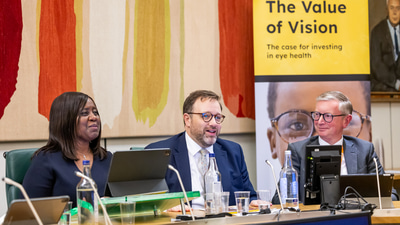
Hosted by Marsha de Cordova MP, chair of the All-Party Parliamentary Group on Eye Health and Visual Impairment, the event featured a panel of leaders from eye health and development to discuss how investment in eye health can accelerate progress in education, livelihoods, gender equality, and poverty reduction.
The panel included Jessica Thompson, deputy CEO of the IAPB, along with Giles Edmonds, clinical services director at Specsavers, Keith Valentine, chief executive of Fight for Sight, and Caroline Harper, the CEO of Sightsavers.
Contributions were made by senior parliamentarians, including Stephen Kinnock MP, Minister of State at the Department of Health and Social Care, and Chris Elmore MP, Parliamentary Under-Secretary of State at the Foreign, Commonwealth and Development Office.
Shockat Adam, MP and optometrist, also joined the meeting, having earlier that day presented a 10-Minute Rule Bill to Parliament to make provision for glaucoma in England.
Panellists discussed the role of primary eye care, research and innovation, global delivery, and international cooperation.
The launch highlighted the opportunity for Parliament to help sustain momentum ahead of the first Global Summit for Eye Health in Antigua and Barbuda in November 2026 – an event the IAPB sees as an opportunity to secure partnerships, commitments and action from ministers to address eye health worldwide.
OT attended the launch and summarised some of the key messages.
1 Evidence-based, solid, credible
Marsha de Cordova commented: “Eye health affects almost all of us at some point in our lives, yet it continues to receive a disproportionately small share of health and development investment. The evidence is clear: investing in vision delivers some of the highest returns in global health, with benefits that extend far beyond healthcare.”
Opening the session, de Cordova highlighted that globally, 2.2 billion people live with vision impairment, and at least half of cases are avoidable or untreated.
Unaddressed sight loss costs the global economy an estimated US$411 billion each year in lost productivity.
De Cordova described the report as “evidence-based, solid, and credible,” encouraging attendees to share it with Parliamentarians.
2 Significant return on investment
The report is one of the largest costings of eye health in low and middle income countries (LMICs) and demonstrates that investing US$7 billion in eye health in LMICs over 2026–2030 will deliver US$199 billion in economic benefits, a return of investment of 1:28.
This marks it as one of the best interventions for return on investment in global health, report writers note.
The total economic benefit is further outlined as $37 billion in employment benefits, $115 billion in occupational productivity, $20 billion in caregiver productivity, and $27 billion in learning benefits.
The investment could curb global sight loss by 24%, preventing 255 million cases by 2030, the report suggests.
Jessica Thompson, deputy CEO of the IAPB, said: “The Value of Vision shows that simple interventions, like glasses and cataract surgery, can transform lives and economies. With proven solutions already available, the challenge now is to secure political will and sustained investment.”
The report sets out six actionable ‘accelerators’ in eye care – practical interventions that are designed for rapid impact at low cost. Thompson suggested that these practical actions are key to the power of the report.
Setting out the case for investing in eye health speaks to “immediacy and transformation” Thompson said, adding that eye health interventions can change a life in a day.
“This issue could be solvable in our lifetime and the feeling of ‘this is possible’ is the penny-drop moment that we need with governments,” she said.
She described the IAPB’s ambition that the summit would garner a “library of commitments” for investing in eye health with a lasting legacy.
3 Leave no-one behind
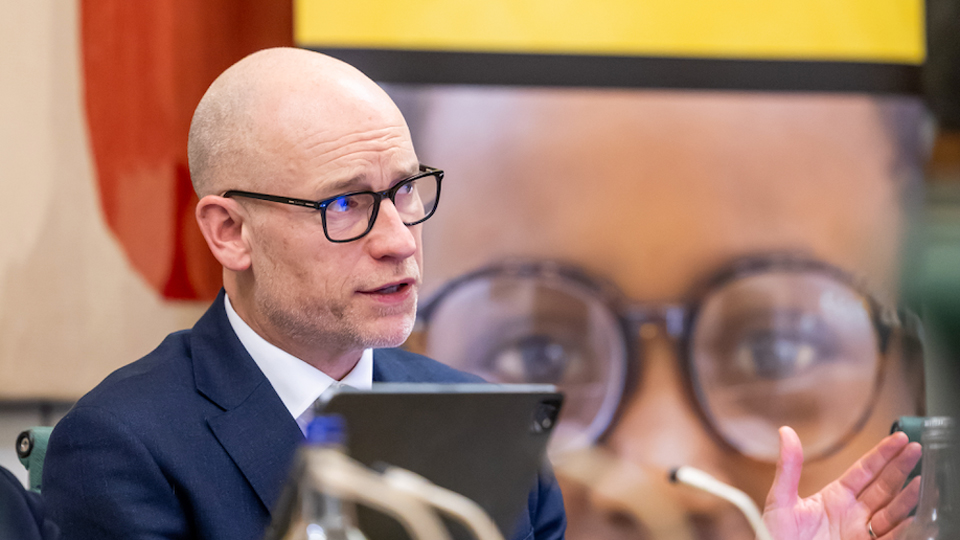
MP Stephen Kinnock joined the panel and spoke of the power of eye care in improving quality of life, sharing his experience of visiting The Village School in London, where children with learning disabilities receive specialist eye care.
Despite positive examples, Kinnock acknowledged that there is still work to be done, particularly in the area of ophthalmology waiting lists.
The MP touched on actions taken by the Government, such as private sector partnerships and the three shifts in healthcare, and what those look like in eye care.
Commenting on the launch of the Value of Vision, he stated: “I think this report from the IAPB reminds us of the number of people worldwide who still go without decent care.”
Eye health is on the cusp of a revolution with developments in genomics and artificial intelligence, he suggested, adding: “How do we ensure the revolution leaves no-one behind?”
4 A postcode lottery in the UK
Giles Edmonds, clinical services director at Specsavers, discussed primary eye care services in the UK, the role of the optometrist, and the drive to remove barriers to access.
Optometry can play a big role in the 10-Year Health plan, Edmonds noted, adding that eye services were listed as one of the first priorities of NHS Online.
However, he highlighted: “The services that patients can access across the country can vary by postcode.”
Some integrated care boards have withdrawn services, he added, which means patients are returning to their GP surgeries and accident and emergency for care.
Edmonds called for improved access to care and “an end to the postcode lottery” of services and highlighted the value in a national eye care framework.
Positive examples of eye care services across the country were highlighted, such as the community urgent eyecare services (CUES) in Manchester.
Bold decision-making is needed to address the postcode lottery, he said, pointing to the approaches taken in Scotland and Wales.
“Optometry has the skill, the technology and the will, so let’s make full use of capacity and capability we have to improve access to care for everyone in communities throughout the UK,” Edmonds said.
5 Progress in technology, research, and global eye health
Fight for Sight’s Keith Valentine spoke of the impact of eye health services on individuals and economies, sharing: “Access to vision services can have a profound impact on the liberty of people to live their lives and contribute to the economy.”
He highlighted the power of the life sciences sector in the UK, and the benefits of taking advantage of advancements in genomics, artificial intelligence, and digital developments.
Speaking of the need for collaboration, Valentine emphasised: “Where sight loss is preventable, we must link arms.”
“The summit gives us a profound opportunity to collaborate and for us to engage the UK economy on this issue,” he added.
Caroline Harper began by paying respect to Lady Jean Wilson, co-founder of the organisation which later became Sightsavers, who has died at the age of 103, recognising her legacy in addressing avoidable sight loss.
Last year marked the 75th anniversary of the founding of Sightsavers, and Harper explained that she had been looking back at what has changed in global eye health.
“We’ve made a lot of progress,” she said, suggesting that when she joined the organisation 20 years ago, eye health was seen as ‘niche’ even in the health sector.
This led to the eye health sector being left out of investment and policies, but this is changing, Harper said.
Significant progress has been made in eliminating blinding trachoma, she said, and refraction is now recognised “front and centre” as a vision problem.
Harper shared her regret at the number of people around the world with cataracts, emphasising that the surgery is simple, low cost, and “transformational.”
For governments making challenging decisions for investment, Harper noted that the Value of Vision report can help make the choice to invest in eye health simple.
She said: “Having the Value of Vision, the commitments, the Summit, we can hopefully see the same successes we have seen with trachoma.”


Comments (0)
You must be logged in to join the discussion. Log in