


18 September 2024
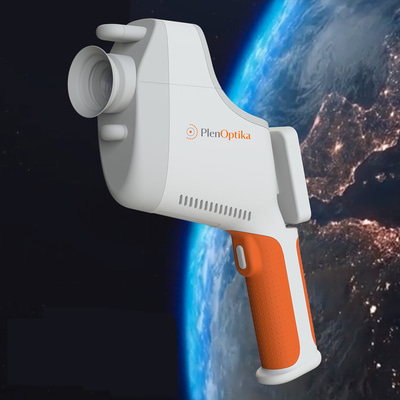
A mobile autorefractor by PlenOptika was sent aboard a recent spaceflight to enable the crew to measure vision changes over a five-day mission.
The five-day mission aimed to advance technology and practices for deep-space exploration, enhancing spaceflight capabilities through extensive scientific research.
An experiment led by Allison Hayman, an associate professor of aerospace engineering sciences at the University of Colorado, observed the biological factors that contribute to spaceflight associated neuro-ocular syndrome (SANS) in microgravity, and the degree of impact on crew members’ vision.
SANS, which is a risk astronauts face in long-duration flights, presents symptoms including swelling of the optic nerve, changes in the shape of the eye, and changes to vision.
The Polaris Dawn crew were equipped with smart contact lenses featuring microsensors to continuously measure ocular pressure. The crew also used the QuickSee Free to measure vision acuity to understand when and how their vision changed.
Watch: SANS research
Shivang Dave, CEO of PlenOptika, said: “We are thrilled to be part of this crucial scientific research, which will help humanity expand its frontiers into deep space.”
Explaining that “it’s every engineer’s dream to be part of space exploration,” he continued: “QuickSee Free’s inclusion in the mission – as the first handheld wavefront abberometry and autorefraction device in space – is a testament to our engineers’ envelope-pushing ability to design technology equal to the demands of health research under the most challenging circumstances.”
A predecessor to the technology used in the autorefractor, QuickSee, was used in pre- and post-flight vision research in collaboration with the Translational Research Institute for Space Health.
The Polaris Dawn mission marks the first time the technology has been used in spaceflight.
PlenOptika’s QuickSee Free is distributed by Grafton Optical in the UK.


Comments (0)
You must be logged in to join the discussion. Log in