


20 August 2026
Whilst on a family holiday in Tenerife, Victoria Walsh noticed something that gave her pause. In the holiday snaps of her son, then not yet two years old, she could see a glow in one of his eyes.
With her concern building, Walsh contacted family friend, Jo Baren – dispensing optician and owner of Jo Baren Eyewear.
Baren discussed the concerns with practice optometrist, Dave Cross, who agreed that George needed to be seen urgently. The family flew home and the practice arranged to see the little boy first thing the following morning.
Baren shared: “Dave wasn’t even meant to be in that day – he came in specially and we opened the testing room just to see George.”
Having seen photographs of the glow in George’s eye, Cross had already contacted Birmingham Children’s Hospital to discuss what the procedure would be for a suspected case of retinoblastoma, should the eye examination support this.
Baren said: “This meant that, before George even came into the practice, Dave knew what we needed to do if, when he looked at him, he thought it was retinoblastoma. We got everything in place.”
What did you identify during the sight test and what was your reaction?
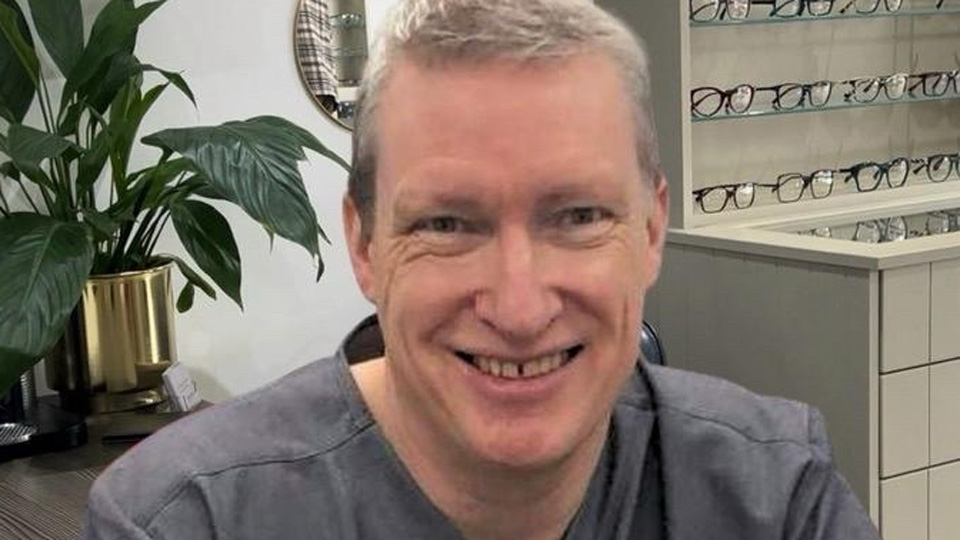
Dave Cross, optometrist at Jo Baren Eyewear (DC): When you see leukocoria in child of that age, you have to fear the worst, which is retinoblastoma. But there are lots of other different causes of a white pupil that you have to discount first.
As soon as I saw the photographs of George’s eye, I said I would come in to see him. It’s that old thing they teach you as a student – if someone asks you to look at their red eye outside of the work setting – as soon as you get involved, your duty of care is triggered.
The white reflex was quite evident when I saw George. We dilated him (which he didn’t like me for), he sat on his mum’s knee, and we had an examination with a pan optic ophthalmoscope which was enough to see a white, round, elevated mass on his retina – including his macula but clear of the disc – that this was quite obviously a tumour. With a lump in my throat, I knew straight away that this was something that needed to be seen urgently.
How did you approach explaining what you had identified/suspected?
DC: The discussion then becomes quite tricky. Nobody trains you to deliver such bad news. I had to be a parent to another parent, explaining as empathetically as I could that George needed to be seen urgently.
If Victoria hadn’t spotted it and questioned it, who knows what the outcome would have been. I found it hard. Delivering such bad news to parents of young children isn’t what I ever signed up for. For me this wasn’t just about his eye, but the possibility of metastatic disease, which I didn’t mention. It was very emotional. Victoria and Dan were obviously very upset, but quite pragmatic about it, wanting to know exactly what to do next – I think they suspected something was seriously wrong because we’d brought them back from holiday so urgently, so they had perhaps mentally prepared themselves for hearing the worst.
What were the next steps that you took, and what was the significance of these steps to this case?
DC: I had already looked at the pathway for retinoblastoma, so I had established that Birmingham Children’s Hospital or Royal London Hospital had the pathway for retinoblastoma referrals, covering all areas of the UK. We referred directly to Birmingham, who accepted the referral email from us.
When did you hear about the results of your referral and how have you been involved since?
DC: The hospital confirmed that George had retinoblastoma. In his case, it became clear that the tumour hadn’t affected the optic nerve – it is right in the centre of his retina. George received local intra-arterial chemotherapy to the eye delivered directly to the retina, from a canula inserted right up to his ophthalmic artery.
Jo Baren, dispensing optician and practice owner, (JB): It has been a long, ongoing process for the family. Victoria takes George [now five years old] to Birmingham roughly every four weeks and will ring me and send the scan results. George has had a reoccurrence recently and another round of chemotherapy injections.
DC: The village community here all know each other and Victoria’s family are quite well known. George is a smashing little lad – kids aren’t fazed by these things. They bounce back after treatment and get on with the fun things in life.
Lightning strikes twice

Jo Baren explained: “Six months after we saw George, another family presented to us with concerns. The family are close friends with Victoria, who has been sharing information on social media about George’s eye, retinoblastoma, and what to look out for. From those posts, this family had noticed something in her own son’s eye.
“The family had visited a GP, who had a look and even called in a colleague for a second look, but ultimately dismissed it.
None of us had ever seen retinoblastoma in practice until two of them presented in our own practice here
“We weren’t due to have a clinic running but again Dave came in during his own time, and we opened the testing room to have a look at this little boy.
“Dave highly suspected retinoblastoma and because we had been through the process already with George, knew to contact Birmingham. The liaison said she couldn’t believe that the same practice had potentially two cases within six months – and in which the families knew each other. It was later confirmed that the little boy did have retinoblastoma.
“My husband [fellow practice owner], Ash, and I have been qualified 30 years. Dave has been qualified 35 years. None of us had ever seen retinoblastoma in practice until two of them presented in our own practice here.”
What would be your three top tips to other practitioners when making a referral?
DC:
- Time is of the essence and the treatment at the Rb centres must start as soon as possible. Look up the pathway for retinoblastoma referrals and how to refer – they will normally see the child the very next day
- If they bring photographs with them, take a look and see if you agree that there is something unusual. Ask them to look back in their galleries for any signs on earlier photos, so you can tell the hospital how long it may have been there
- Check out the latest retinoblastoma treatment modalities. In my discussions with Victoria and Dan, I told them enucleation could be a possibility, however the treatment centres will do anything they can to save the eye, whether sighted or not.
- And if I am permitted to give just one more… be prepared to put yourself out, that’s what being a community optometrist is all about.
JB: You would want somebody going out of their way to get your child seen as soon as possible. Getting the child in as soon as possible, doing the background work to find the pathway and arranging the referral as quickly as we can – I would do it over and over again because that is how I would want somebody looking after my child.
Victoria Walsh shares George’s journey to diagnosis and treatment

“We were on holiday when I kept noticing a glare in George’s eye. We took a photo and could see a white glow. My husband and I Googled it and thought it can’t be [retinoblastoma], it doesn’t happen to everybody, but the next day my husband saw the glare in natural light.
“I rang Jo, our local optician, but also a family friend. I explained what I could see and sent some photographs. Jo said she would book us in for when we got home.
“But the more I looked at the pictures, the more I worried. I rang her back and asked: ‘Will you tell me as a friend – should we stay for the rest of the holiday or come home?’ She was honest and said that, if it was her, she would come home. We got a flight that night and Jo had us booked in for the next morning at 9 o’clock.
“The optometrist looked in his eye and confirmed that yes, he could see something and that he’d like us to be checked over by the hospital to confirm it. Within half an hour of us leaving the appointment, Birmingham Children’s Hospital already had the referral.
“We were seen within three days at the hospital where we’ve been going at least every month for three years since. They confirmed it was Stage D retinoblastoma. He started intra-arterial chemotherapy the week after and we’ve had laser every month since.
They confirmed it was Stage D retinoblastoma
“People need to be aware of children’s eyes and if there is a squint or colour change, to go and get it checked out. If you think something’s not right, pursue it. I find myself going through people’s photos and looking out for the white glow.
“George has been back with Jo – I wanted him to have an appointment so I could see what the optometrist would be able to see, but also to show George that going to the practice isn’t scary. Me, my husband and my little girl all go there now.
“George can’t see out of that eye. But he is very lively and he can still do so much even though he’s got one working eye. He doesn’t miss a trick.
“Everyone has been brilliant. The team at Jo Baren Eyewear, the hospital, and CHECT have all been amazing. CHECT has been with us every step of the way. I held a ball for them this year and raised £16,000 – that's how grateful I am.”


Comments (0)
You must be logged in to join the discussion. Log in