


17 June 2026
A multi-disciplinary team from the University of Manchester has been recognised with an award for its reimagined induction experience for first-year optometry students.
The European First Year Experience (EFYE) conference, this year held in Szeged in Hungary, draws together academics and university staff to discuss supporting students through the transition into university.
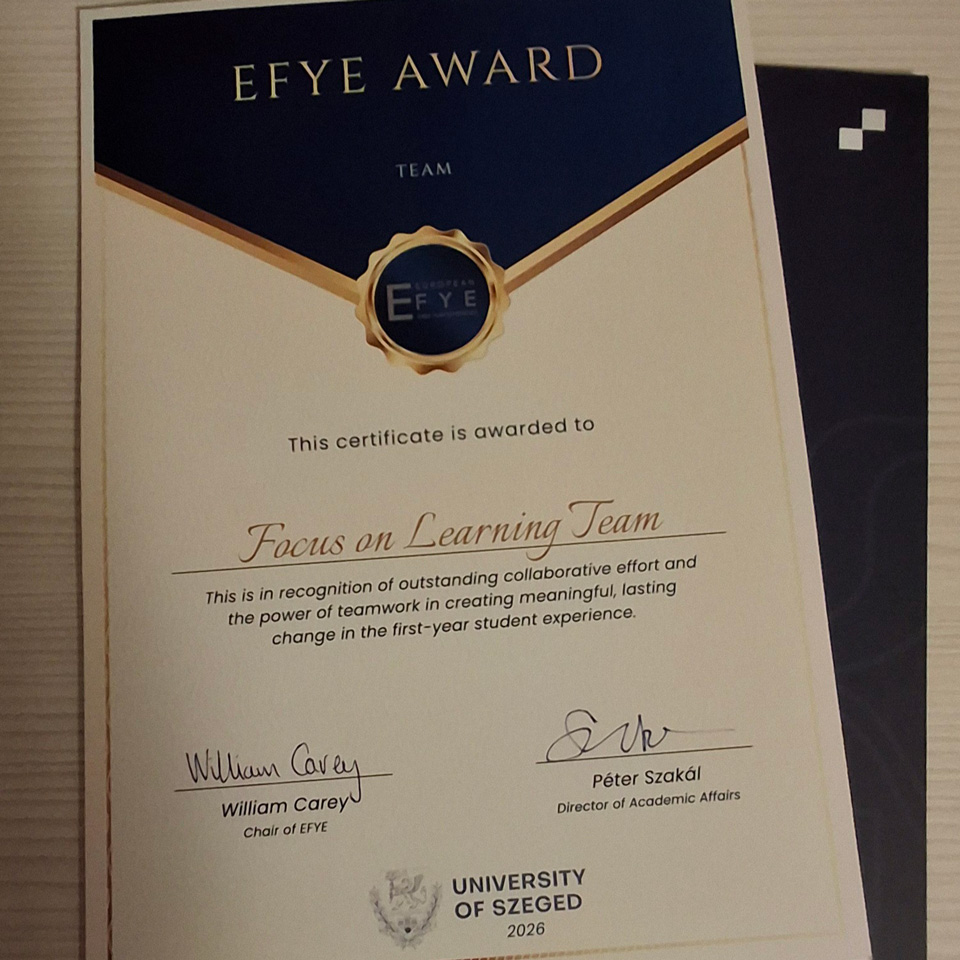
The University of Manchester’s Focus on Learning team received the EFYE Team award in recognition of its four-week induction period for first-year optometry students.
OT spoke with Catherine Collin, senior lecturer in optometry, and Andrew Gridley, senior lecturer in optometry education, at the University of Manchester to find out more about Focus on Learning.
The move to university
Describing the transition into university, Collin emphasised: “It’s a huge change for a lot of students. A lot of them are moving away from home for the first time. They’re losing their support networks, their sports teams, their friends. They are moving to a new city. You also have issues of finances and accommodation. So it’s really about trying to make them feel they belong as part of the university and that there are support networks.”
Following the launch of the university’s new integrated Master of Optometry course in 2024, the academic team took the opportunity to redesign the induction experience.
A central feature of the new course is the Team-Based Learning approach, and in replacing the traditional ‘Welcome Week’ format of induction with a four-week programme of activities, the team aimed to foster the collaborative culture between first-year students that would be necessary for team working.
Collin said: “We really needed the students to feel that they belonged and that they could engage with the team-based learning. We needed to set them up to prepare for that.”
Creating belonging
Gridley said: “The key point of those first four weeks is to try and build a sense of belonging for the students.”
Gridley said: “What we wanted to do was create a situation where we were making connections between the students themselves, between first-years and second-years, and the other years of the course, and between students and staff.”
“Finally, we wanted them to have a connection with the places around the university. A lot of our students commute in, so they traditionally would have come into our building for a clinical session or lecture and have gone back home again. We wanted students to feel like the campus was theirs,” he added.
The Focus on Learning team achieved this through organised trips to Manchester Museum, the Museum of Medicine and Health, and the Whitworth Art Gallery.
Rather than meeting tutors in their offices, students were invited to meet the academic advisors at different coffee shops around the campus.
Students engage in icebreakers, events, wellbeing sessions, and activities to mix and meet one another.
Gridley described the first activity students are tasked with: “We take 12 to 14 trial cases full of lenses and dump them out. Their first team activity is who can get them back in the box the fastest. In terms of an icebreaker, that works really well and sets the tone for the rest of what they will do.”
Academic and optics-focused content is spread throughout the four-week period.
Collin explained: “The academic content is intermingled with all of the other activities and, during the first four weeks, it is very light touch and focused around bringing all students up to the same level.”
“We do a lot of team-based activities and games, which the students really enjoy. They are learning, but they are also having fun and communicating with each other,” she shared.
Measuring the impact
The academic team recently published a paper sharing an evaluation of the induction programme – formerly known as Learning to Learn – finding students reported an increased sense of belonging, engagement and self-confidence.
Surveying the cohort of 80 first-year students in the 2024-25 academic year, the team found that 71% responded ‘yes’ to the question: “Do you feel part of the optometry community?” Another 29% responded ‘partly,’ while there were no negative responses.
End of year data showed higher engagement and belonging scores than the previous cohort.
Based on the success of this approach, other courses within the university have begun implementing elements of the approach, while there has also been interest from other universities.
International recognition
Reflecting on the award win, Gridley said: “We’re really happy, particularly because it feels like this might mean others start to approach it in this way. We do feel like it’s something that could be rolled out to a wider group and different courses in the university.”
Receiving the team award also recognised the “huge” amount of teamwork that had gone into the design of the induction period, Collin said – which involved the optometry department, the museums, the art gallery, and many others.
She shared: “It was a huge surprise and we were really pleased to receive the award and the recognition – and on a European level. I think it shows that we do need to shout about optometry education a little bit more. There is a lot of literature on medical education – for medics, pharmacists, and nursing – but very little on optometry education. It is good to get that international recognition.”


Comments (0)
You must be logged in to join the discussion. Log in