


21 May 2026
Researchers in Japan and Israel have provided insight on microsporidial keratoconjunctivitis (MKC) following an outbreak that affected more than 100 athletes in Darwin caused by Vittaforma corneae.
In March this year, Nagasaki University associate professor, Masafumi Uematsu, and colleagues published research outlining the environmental catalysts behind two MKC outbreaks among 16 Japanese athletes in 2022 and 2023.
“Both outbreaks occurred during the summer season and were preceded by heavy rainfall that caused the playing fields to become muddy,” Uematsu said.
PCR testing of samples taken from the soil the football players trained on revealed the same pathogen as identified in corneal scrapings.
Uematsu shared with OT that before the cluster of cases among healthy football players described in the research, cases of MKC were rare in Japan.
There were single cases of microsporidial stromal keratitis in immunocompromised patients in 2016 and 2019, and an instance of MKC diagnosed in a patient who had recently returned from Singapore.
“Prior to this event, only sporadic cases had been reported,” he said.
“Since these cases, further outbreaks among other soccer teams as well as cases in rugby and golf players have been observed in Japan, giving the impression that the number of cases may be increasing,” Uematsu said.
Uematsu shared that research suggests microsporidia may already be present in the environment even in regions previously considered non-endemic.
“Climate change–associated increases in rainfall, flooding, and warm humid conditions may increase the environmental burden of microsporidia to levels capable of causing infection, thereby potentially influencing the frequency and geographic spread of MKC outbreaks,” he highlighted.
The Nagasaki outbreaks
The 16 patients included within Uematsu’s research were healthy men between the ages of 17 and 36.
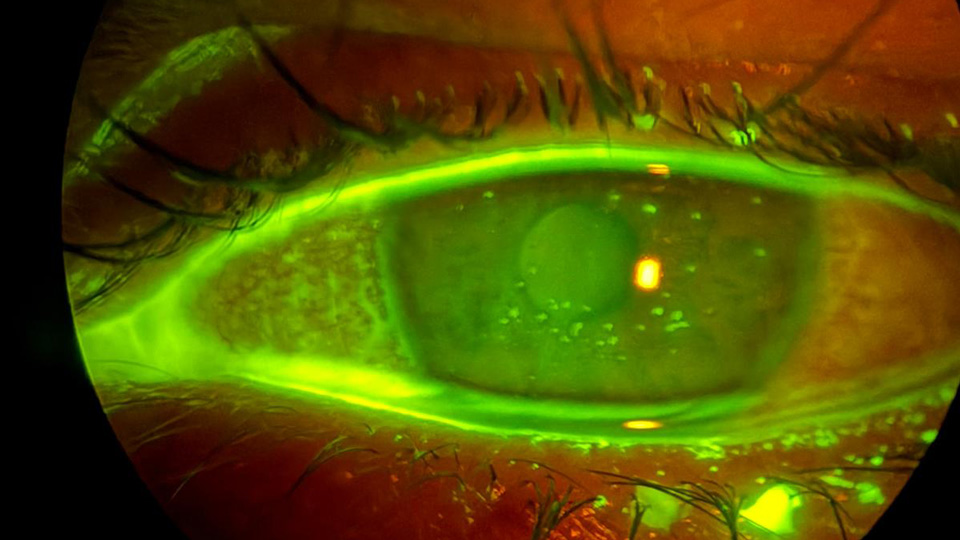
The research paper noted: “Patients experienced a decrease in best-corrected visual acuity, redness, eye discharge, pain, itching, and a foreign-body sensation. More severe manifestations include corneal opacities, multiple subepithelial corneal infiltrations, and dazzling light, which make it difficult to see the ball while playing football.”
All men included within the research made a full recovery following treatment with voriconazole eye drops, 1.5% levofloxacin eye drops, pimaricin eye ointment and iodine or polyvinyl alcohol eye drops.
Uematsu highlighted that symptoms among most patients resolved within two weeks.
“We have not experienced cases showing obvious recurrence within a short period after initial resolution,” he said.
“However, in some patients, subepithelial corneal infiltrates and photophobia persisted,” Uematsu observed.
The researchers determined that MKC outbreaks tend to occur following a month with –or exceeding – the following weather conditions: a temperature of 23 °C, a humidity of 70%, and a rainfall of 200 mm.
They added that there may be a lag time between these weather conditions occurring and the onset of MKC cases.
“The mechanism remains unclear, but heavy rainfall, humidity, and high temperatures may promote proliferation of microsporidial organisms in soil and surface water,” Uematsu explained.
“Delayed exposure, incubation time, and gradual recognition of cases may contribute to the lag between weather events and outbreak detection,” he added.
Climate change–associated increases in rainfall, flooding, and warm humid conditions may increase the environmental burden of microsporidia to levels capable of causing infection, thereby potentially influencing the frequency and geographic spread
A focus on prevention
Following the Nagasaki outbreak, players were advised to rinse their eyes with artificial tears or sterile eyewash solutions following exposure to muddy water.
“In cases of significant muddy water exposure, povidone-iodine eye drops may be considered under medical supervision,” Uematsu shared.
He added that because eliminating environmental pathogens from outdoor fields is difficult, preventing future outbreaks should focus on reducing exposure.
“Avoiding play on heavily muddy fields after rainfall, improving awareness among athletes and medical staff, and encouraging early ophthalmologic evaluation may help reduce outbreaks,” Uematsu said.
Uematsu noted that while standardised surveillance methods for MKC have not yet been established, environmental monitoring could include PCR-based testing of soil and surface water samples together with monitoring of rainfall, soil moisture, and temperature.
“A seasonal alert system could notify sports organisations and healthcare providers before rainy seasons about the symptoms and risk factors of MKC, particularly muddy field exposure. Early awareness may facilitate prompt diagnosis and prevention,” he said.
Uematsu added that while his research has explored treatment and prevention approaches, standardised treatment protocols for MKC in healthy patients have not yet been formally established through clinical practice guidelines.
The Sea of Galilee outbreaks
Dr Asaf Friehmann and colleagues described 12 cases of MKC confirmed through PCR testing in research published in Emerging Infectious Diseases.
The cases, which occurred between 2022 and 2024, were all linked to the Sea of Galilee in Israel.
Friehmann, who is the head of the cornea unit at Sheba Medical Center, told OT that he only began seeing cases of MKC in Israel around three to four years ago.
He noted that while climate change is not his area of expertise, this may be influencing the rising number of cases in geographic regions where the infection has not previously been reported.
“According to well-established studies, the temperature of the sea is increasing. It may be that the increase in temperature is enough to change the microbiology of the Sea of Galilee,” he reflected.
Friehmann estimated that he had seen “dozens” of cases of MKC over the course of his career – although not all of these cases were confirmed through PCR testing.
He told OT that patients commonly presented with a red eye, blurred vision and a foreign body sensation seven to 10 days after exposure to the Sea of Galilee.
Most patients reported that they had been swimming – although two patients with confirmed MKC had only been exposed to the sand.
While most patients made a full recovery, Friehmann noted that some patients experienced scarring in the anterior stroma.
The official public health guidance following the MKC outbreaks was to wear goggles when swimming in the Sea of Galilee. However, Friehmann believes there are limitations to this approach.
“We saw swimmers who used goggles who suffered from the infection,” he said.
“Just because you wear goggles, it doesn’t mean that you keep them on the whole time or that drops might not enter the goggles during the swim,” Friehmann said.
He recommended that people who visit the Sea of Galilee use 0.02% chlorhexidine and vitamin eye drops as a precaution.
These eye drops are available over the counter without a prescription in Israel.
“It has a very broad coverage and the ocular surface tolerates it well,” Friehmann said.
A Darwin athlete describes his experience of parasitic eye infection
Samuel Wright, 25, started experiencing symptoms in his left eye two weeks after playing for the Jabiru Bombers Football Club in March.
“It started closing up and going red,” he said.
“I had a black eye. It looked like I had been in a fight,” Wright shared.
After he was initially prescribed chloramphenicol by his GP, he experienced little relief in his symptoms.
Wright was prescribed Ocuflox and Maxidex eye drops after visiting a Darwin optometrist.
Two months after the infection, Wright was continuing to take daily eye drops.
“Nearly all of last week I had clear vision in my left eye and I was thinking ‘I’ve healed,’ but in the past few days I’ve had some blurriness,” he said.
Wright told OT that the initial period of uncertainty around what was causing the outbreak of eye infections was unsettling.
“It seemed like nobody knew what was going on. I know that there are other sicknesses that are worse, but your eyes are pretty important,” Wright shared.
During the initial phase of the infection, Wright took a week off work from his job as a legal assistant.
“They weren’t sure if I was contagious or not. I spent a week lying in bed doing nothing. Even looking at a screen was blurry,” he said.
Wright shared that people in Darwin are already generally cautious about mud because of melioidosis – a bacterial infection that can be contracted through contact between skin abrasions and contaminated soil.
However, he said he would be more cautious about playing on a muddy field in the future.
“If I knew it was still there [Vittaforma corneae] and there was a chance of the eye infection coming back, I just wouldn’t play,” he said.
“It’s not worth risking your health,” Wright added.

Inside a mysterious eye infection outbreak among Darwin AFL players
Is it a viral infection or linked to the pitch itself? OT reports on a spate of keratoconjunctivitis cases that has spread to 71 players


Comments (0)
You must be logged in to join the discussion. Log in