


04 February 2026
The stories of adversity that bring patients to sit across from Dr Alfonso Vasquez–Perez are various: vision lost through the gradual but inexorable progress of autoimmune disease, worlds changed in an instant through chemical injuries, acid attacks and dog bites.
Whatever diverse experiences bring them to his door, the patients Vasquez–Perez sees are all searching for one elusive thing.
“They are looking for hope,” he told OT.
With the support of a 20-strong team, the Moorfields Eye Hospital consultant ophthalmologist and his multidisciplinary team including one maxillofacial surgeon from St George's Hospital are the only clinicians in the UK who performs osteo-odontokeratoprosthesis (OOKP) operations.
The surgery can result in a patient progressing from light perception to an almost complete recovery of their vision.
During two seven-hour operations three months apart, patients with healthy retinas and irreversibly damaged corneas have a chance at regaining vision through an implant constructed from their own tooth.
“It’s most rewarding when you see such a huge change in their vision and quality of life,” Vasquez–Perez said.
The procedure, which is also known as tooth-in-eye surgery, was pioneered by Italian ophthalmologist Professor Benedetto Strampelli in the 1960s.
Strampelli saw the advantages of employing dentin and the bones surrounding dentin as an organic material that is resistant to desiccation.
OOKP is currently performed by very few centres around the world because it requires a multidisciplinary team including a maxillofacial surgeon, anesthetists, a radiologist and psychologist.
The Moorfields OOKP Service is offered through their Eye Centre at St George’s Hospital, London, with the support of the host trust’s maxillofacial team led by Rahul Jayaram.
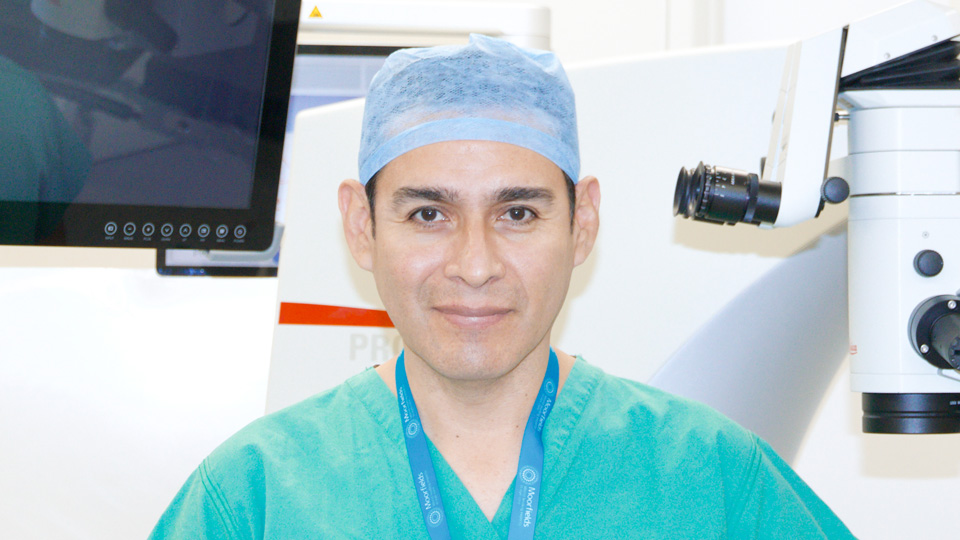
Vasquez–Perez, who is the clinical lead for the Moorfields OOKP Service, shared with OT that around five patients will have the surgery performed each year in the UK.
Patients who come through the service often have autoimmune disease, such as Stevens-Johnson syndrome, or chemical injuries.
“This is a treatment that is available only in a very few places around the world, and is marvelous because it can restore vision in completely blind patients who cannot have a corneal transplant,” he said.
The multi-stage procedure sees a live tooth and surrounding bone harvested from the patient’s mouth. The tooth dentine and bone is then hollowed out and shaped into a lamina that will act as the casing for an acrylic optical cylinder.
It’s most rewarding when you see such a huge change in their vision and quality of life
The tooth is implanted in a sub muscular pocket, usually in the contralateral cheek, and left for three months, where it becomes embedded in the soft tissue.
At the same time all scars from the ocular surface are removed and the eye is covered with buccal mucosa (the tissue lining the inside of the cheek).
The second operation sees the lamina removed from the cheek and implanted in the front of the eye after dissecting and reflecting the buccal mucosa, creating a central opening of the cornea and removing the iris, the lens and the vitreous. The reflected buccal mucosa is then repositioned to cover the lamina, with the optical cylinder creating a small circular opening on an otherwise pink eye.
“The optical cylinder is the window where patients can see,” Vasquez–Perez explained.
He added that the implants have a high degree of biocompatibility. One patient operated on more than two decades ago has maintained vision with the same original prosthesis.
“The longevity of the device is very good. It is the is the most enduring type of artificial cornea worldwide,” Vasquez–Perez highlighted.
Describing the impact of the operation, Vasquez–Perez recalled a patient who was looking forward to seeing his family and friends at Christmas after years of only hearing their voices.
Another patient was able to see his daughter as an adult for the first time after losing his vision when she was a toddler.
“The gratitude from the patients is remarkable,” Vasquez–Perez said.
A Manchester United fan is on the waiting list and he is hoping to attend a match after recovering from his surgery.
“He says that he wants to be able to go to the stadium, see the crowd, see the players, and that will make him happy,” Vasquez–Perez shared.
“I'm a football fan too. Even though his team is not my team, I will be happy for him too,” he added.


Comments (2)
You must be logged in to join the discussion. Log in
Anonymous05 February 2026
One of the first surgeries in the UK using this technique was performed around 20 years ago by a British ophthalmologist. There may be others before that. Let's acknowledge those that have achieved this in the past.
ReportLike4
PujaMalkani05 February 2026
💚
ReportLike0