


08 June 2026
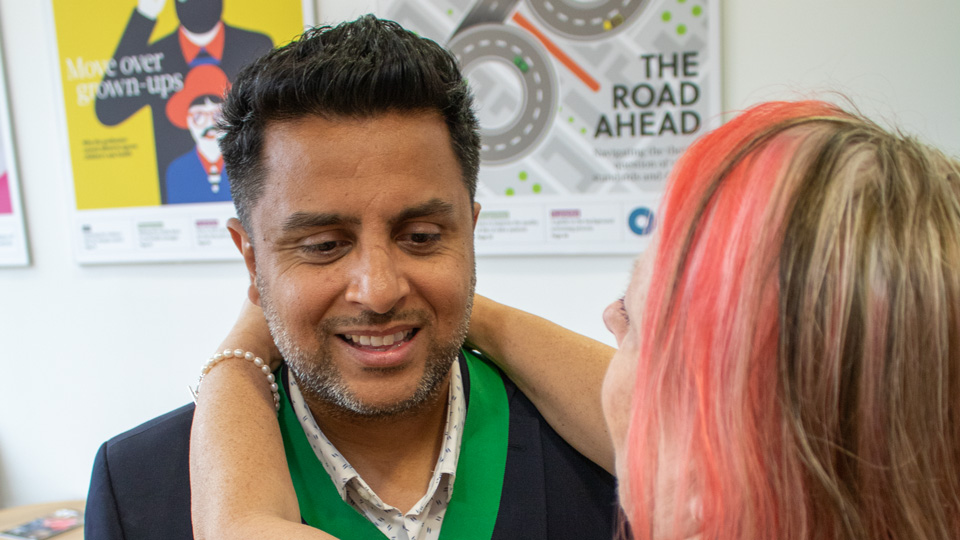
Last week, optometrist, Emma Spofforth, officially stood down from the role of AOP chairman following a three-year tenure, handing the medal of office to optometrist and Board member, Nizz Sabir, at the association’s annual general meeting (3 June).
Spofforth remains on the association’s Board as immediate past chairman, but steps down from Council after 14 years.
Speaking to OT ahead of the handover, Spofforth reflected: “I’ll really miss the discussions and debates. Council has been a huge part of my professional life.”
Stepping into the role of chairman, Sabir told OT that he is “looking forward to the challenge of supporting the Board, our Council colleagues and, most importantly, our members.”
Ahead of the official handover, OT sat down with the outgoing and incoming chairmans to learn about the evolution of the profession, leadership, and keeping members at the centre of the association.
Finding the next chairman
While the formalities of chairmanship handover took place last week, behind the scenes, the handover between Spofforth and Sabir has taken place over the course of a year.
Having worked closely over a number of years in their roles on AOP Council and Board, Spofforth and Sabir described the handover as a gradual process that has been designed to ensure continuity and collaboration.
Spofforth told OT that one of her proudest achievements as chairman has been preparing for the future of the organisation – identifying Sabir as her successor and helping him prepare.
“One of my most important achievements has been finding a suitable replacement for me,” she said.
“Having continuity really matters,” she added.
The role of AOP chairman is more extensive than many may realise, as Spofforth revealed.
“The role of chairman is fascinating because it operates on several levels,” she shared.
“You lead Council meetings and encourage councillors to share their experiences and perspectives on behalf of the profession. Seeing that diversity of opinion and expertise around the table is one of the most rewarding parts of the role,” she explained.
In addition, the chairman works closely with the association’s executive team and Board, overseeing its governance and helping to shape the organisation’s strategic direction.
“There’s a huge amount of work involved in ensuring members’ money is being spent appropriately and strategically,” she said.
“Members often don’t see the sheer amount of work that goes into running an organisation like the AOP,” she added.
A good leader doesn’t need to have all the answers. You need to create space for other people’s voices and perspectives
Reflecting on three years ago as she stood in Sabir’s position preparing to begin her tenure as chairman, Spofforth admitted that stepping into the role initially felt daunting.
“Taking over from Julie-Anne was intimidating,” she recalled.
“I didn’t want to simply follow directly in her footsteps. I wanted to bring my own personality to the role while supporting the Board and Council, and hopefully with a bit of humour too,” she shared.
That experience has shaped the way she has approached succession planning. Rather than viewing the handover as a brief transfer of responsibilities, Spofforth and Sabir have worked together over the last 12 months to ensure knowledge, context and relationships are passed on effectively.
Discussing the process, Spofforth explained: “I felt it was important to have a long and structured handover. Nizz has joined CEO meetings, attended Board sub-committees and been included in key discussions very early on.”
She has also prepared detailed handover documents and arranged regular meetings to discuss ongoing priorities.
“When I first stepped into the role, it probably took me longer than I’d have liked to fully understand everything, so I wanted to make that transition smooth,” Spofforth said.
Sabir describes the experience as invaluable preparation for taking on the role.
“Emma has been incredibly open and thoughtful throughout the process,” he told OT.
“That level of approachability has made a huge difference. It’s given me confidence going into the role,” he added.
Council is the engine room of the organisation, and that experience is invaluable
While the responsibilities of chairman encompass governance and strategy, it also involves leadership. Both optometrists shared that effective leadership begins with listening.
For Spofforth, creating space for others to contribute is one of the most important aspects of the role.
“A good leader doesn’t need to have all the answers. You need to create space for other people’s voices and perspectives,” she said.
“You have to be able to reflect honestly on yourself and accept feedback,” she added.
Reflecting on Spofforth’s tenure, Sabir described her as a steady and authentic presence.
“We align on a lot professionally, especially around commissioning and primary care, but we’re also very different people,” he said. “That balance is healthy. Leadership needs personality as well as stability,” he added.
While continuity is important, Sabir recognises that every leader brings something different to the role.
“Someone once gave me a Bake Off analogy: everyone starts with similar ingredients, but each person adds their own flavour,” he said. “That’s probably the best way to describe leadership transitions.”
Sabir told OT that authenticity is one of Spofforth’s greatest strengths.
“She’s never tried to perform the role,” he said, adding: “People respond to authenticity.”
On stepping into the shoes of chairman, Sabir said his years on Council and Board have provided a strong foundation.
“Council is the engine room of the organisation, and that experience is invaluable,” he said.
“Having the support of an immediate past chairman is incredibly important because they’ve already navigated many of the same challenges,” he added.
Some areas have excellent enhanced pathways, while others have very little. That inconsistency is frustrating for both practitioners and patients
Optometry and change
As optometrists first and foremost, Spofforth and Sabir have decades of experience in practice, on the ground providing them with first-hand insight on how the profession has evolved over the years and the challenges that lie ahead. While today optometry has opportunities that would have been difficult to imagine at the start of their careers, both know that change continues to accelerate.
Spofforth, who has ample experience working in primary care practice, reflected: “When I first started training, optometry looked very different.”
“Now we’re seeing expanded clinical roles, independent prescribing, medicines management and increasing integration into wider healthcare delivery,” she added.
For Spofforth, one of the most striking developments has been the growing breadth of expertise across the profession, as optometrists now work across a wide range of clinical settings and pathways.
She believes this professional evolution has also been reflected in AOP Council, where members bring increasingly diverse experiences and perspectives to discussions about the future of eye care.
“The conversations [on Council] have become much richer,” she said. “You’ve got people from primary care, hospitals and commissioning backgrounds all bringing different perspectives,” she added.
Sabir agreed: “If you compare AOP Council now to what it looked like 20 years ago, the diversity of thinking is incredible.”
“At the same time, experience and stability remain hugely important,” he added.
Both practitioners point to the ongoing development of primary eye care services as one of optometry’s biggest opportunities.
Spofforth has spent a number of years working with local optical committees to secure commissioned services and improve patient access. Despite progress, she believes significant variation remains.
“We still have too much postcode variation in England. Some areas have excellent enhanced pathways, while others have very little. That inconsistency is frustrating for both practitioners and patients,” she said.
Sabir acknowledged how wider NHS pressures are affecting this. “The healthcare system is under enormous pressure,” he said, adding: “General practice is stretched, A&E departments are overwhelmed, and primary care optometry is uniquely placed to support patient access.”
“Whether you live in Newcastle or London, services should be consistent. Patients shouldn’t face a postcode lottery,” Sabir added.
The AOP is a membership organisation, and members are central to everything we do
More than indemnity
For both Spofforth and Sabir, members remain at the heart of the AOP’s work and future direction. While indemnity is an important part of the organisation’s offering, both optometrists emphasised that the AOP’s role extends far beyond providing protection.
“I’d encourage members not to think of the AOP purely as an indemnity provider,” said Spofforth. “The organisation offers so much more, from education and events to professional support and guidance.”
Throughout her own career, Spofforth has seen first-hand how engagement with the association can open unexpected doors. “Engage with the AOP. Attend events, read the journal, share feedback and consider getting involved in Council yourself,” she urged. “That’s how my own journey started. Someone encouraged me to put myself forward, and here I am today,” she added.
Looking ahead, Sabir hopes that increased regional engagement and upcoming roadshow events will help further strengthen relationships between members and the organisation.
“We want members to feel connected to the organisation, and one of the ways we’ll be doing that is through more regional engagement and roadshows,” he explained.
Sabir highlighted that at its core the AOP exists to support optometrists and dispensing opticians at every stage of their professional lives. “The AOP is a membership organisation, and members are central to everything we do,” he said.
“Whether someone is newly-qualified or approaching retirement, we want them to know that the organisation is there throughout their entire career,” he added


Comments (0)
You must be logged in to join the discussion. Log in