


In episode 17 of The OT Podcast, we speak to AOP education lead, Dr Byki Huntjens.
Optometrist Byki grew up and originally trained the Netherlands. She went on to complete her MSc and PhD at the University of Manchester before working in independent practice in London and later in academia as a lecturer at City St George’s (formally City, University of London).
Today Byki is an independent education and research consultant in contact lenses and dry eye, an honorary research fellow at City St George’s, president of the British Contact Lens Association (BCLA), and education lead at the AOP.
Here are four things we learned about Byki when recording The OT Podcast.
1 Optometry was a coincidence
As a teenager deciding on her next steps in education, Byki described a desperation she had to find her passion, but also to leave the village in which she grew up.
Deciding to study optometry was a coincidence and one that later resulted in her discovering her passion.
She shared: “I picked up a careers book in the library at the High School I was attending in the south of the Netherlands and I opened it up on O. I ended up reading about being an optician. I thought, ‘Ok, I’ve got nothing to lose,’ so I went to the local opticians in our village… I still remember walking in. I was so intrigued by the frames, and I thought, this has real potential.”
However, following that exploration visit, Byki was not necessarily going to become an optometrist. “Initially I thought I wanted to go into designing frames,” she said. “But then I went to the open day at Utrecht University, which was a two-and-a-half-hour train ride away from home, and I was sold.”
Her optometry open day experience as a perspective student is something that has stuck with her during her career: “They showed me how exciting the profession and a career in optometry could be.” She strove to do the same for those who were considering optometry when she was a lecturer at City St George’s.
2 From practice to academia
Byki arrived in London post-PhD and worked in independent practice.
Her path began to diverge into academia when contact lens educator, Judith Morris, whose books Byki fondly remembers reading, asked her to help in the contact lens clinic at City St George’s.
“That’s how I started at City, as a visiting clinician one day a week,” Byki shared.
At the time, Byki was also working on the High Street as a resident optometrist in independent practice. She was enjoying clinical practice and the progressive practice owner who allowed her to advance her skills.
“It was very exciting because I was very quickly allowed to expand the clinical practice that we were offering already in the practice,” she said.
Byki had an interest in dry eye and as a result she established a dry eye clinic at the practice. “I simply had to present it as a business proposal to the owner,” she said.
Enjoying clinical practice, a lectureship became available in the optometry school at the university. “I wasn’t sure if I was the right person for it, if I’m honest,” Byki said.
Yet after much consideration (and persuasion from her husband), she did apply, and she got the job.
Reflecting on teaching, Byki said: “I love teaching clinics or labs, or even in the lecture room. I like finding new ideas to make it interesting.”
However, she admits that this enthusiasm also took a lot of energy as she was always rewriting her lectures and trying new ways of inserting technology and building engagement.
“I think that’s how the students saw me – they may not have always been interested in contact lenses, but they knew they had an enthusiastic educator there,” she said.
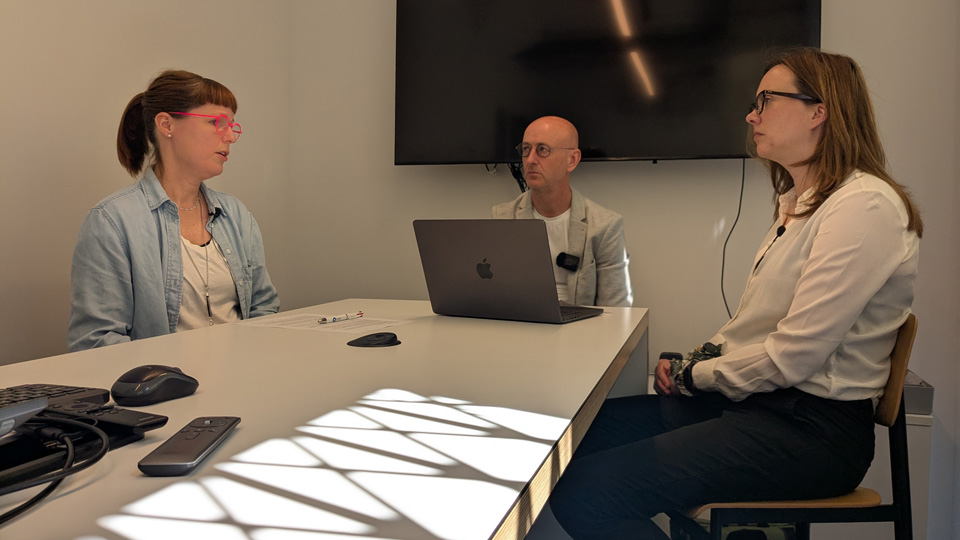
3 A love for contact lenses and being a ‘doer’
Byki has always had “a lot of passion” for contact lenses.
“You can go deep, but it’s quite focused,” she explained.
“With contact lenses there are multifocal, toric, spherical, soft and ridged, scleral, and ortho-k. There is so much out there. I thought that it was a really nice, niche area,” she reflected, adding: “Dry eye came with it because at some point you get a lot of contact lens dropout, and you realise that the ocular surface is not able to maintain comfortable wear time.”
She is also a ‘doer,’ and has been involved in a wide range of UK and international contact lens-related research, education and organisations.
“If people ask me to do something, I’m a doer, so I just do stuff if think it’s interesting, particularly as I’m not from the UK – you don’t realise how good you’ve got it in the UK education wise,” she said.
This has led to Byki’s involvement with the BCLA, the Netherlands Contact Lens Congress, TEFOS, and the International Association of Contact Lens Educators (IACLE), to name but a few of her volunteering roles.
The importance of the role of IACLE as an organisation is something Byki feels strongly about, having accessed the organisation initially as a lecturer in search of images to use when teaching.
She highlighted that some educators globally do not have access to the tools and resources they require so it’s hard for those studying optometry to learn about contact lenses – which is where IACLE comes in.
“Accessibility of eye care generally is not equal – I like to give something back,” she said.
4 Byki is a science communicator
Today, Byki has a portfolio career, splitting her week between a variety of paid-for and volunteer work. She likes to call herself a science communicator.
She spends two days a week working at the AOP as an education lead – a role she was appointed to in 2024 – and the rest as a consultant.
As a science communicator, she is trying to demonstrate and use evidence-based practise with practising eye care professionals in order to create a link between the science and the patient.
“There’s such a gap between what the research does and says versus how we convey that message to patients. I like that translation, which is almost like a different language,” she said.
The Dr Byki Huntjens episode
The OT Podcast
OT will release a new episode of The OT Podcast bimonthly. You can listen to The OT Podcast on our website, or via all the main podcast apps, including Apple Podcasts, Spotify and Castbox. Be sure to catch-up and listen to other episodes, featuring experts including Imran Hakim, Ian Cameron, Dame Mary Perkins, and Professor Nicola Logan.
Remember to subscribe to The OT Podcast to ensure you never miss an episode.
The Dr Byki Huntjens episode



Comments (0)
You must be logged in to join the discussion. Log in