


20 May 2025
Around 250 local optical committee members gathered at the Hilton Birmingham Metropole for the National Optical Conference (18-19 May).
Opening the conference, Local Optical Committee Support Unit (LOCSU) chair, Dr Joy Tweed, paid tribute to the work of optical professionals leading change in their communities.
“There’s great innovation that is taking place, and we look forward to learning more over the next couple of days,” she said.
“It is through sharing and harnessing the power of the LOC community that we will build the evidence to lead change,” Tweed emphasised.
Looking back to look forward
In her presentation to delegates, Professor Sally Lewis described principles of systems leadership in uncertain times.
Lewis recalled a recent trip to the US where an LA doctor had described the effect of executive orders and legislative change on his practice.
“Overnight, programmes to serve those most disadvantaged in his community were being cut,” she said.
“What was fascinating to me was his reaction to this. He didn’t accept this but instead reached out to colleagues to find solutions so that he could continue to care for the population around him,” Lewis emphasised.
Lewis observed that while it may feel like the world rules are changing – in healthcare and beyond – this predicament is not unprecedented.
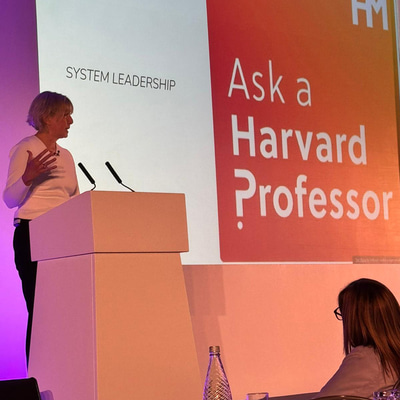
“The chaos we feel has been described before,” she said.
At the end of the Cold War in the 1980s the US army military college described the concept of VUCA – representing volatility, uncertainty, complexity and ambiguity.
Lewis highlighted that volatility provides a sense that the goal posts are always shifting.
“What's the antidote to volatility? It's clarity of purpose. It's feeling that we know where we want to get to and we will keep aiming for that even when we are buffeted away from our goal,” she emphasised.
Lewis worked closely with optometrists in her former role as a GP and primary care clinical director working in South Wales.
As she left the role 10 years ago, Lewis decided to explore the current state of eye care in preparation for her presentation.
“I was amazed by how much progress has been made over the last decade,” she emphasised.
“I’m sure that you feel frustrated and would like to go further and faster, but I can objectively tell there has been considerable change,” Lewis emphasised.
As primary care clinicians, Lewis highlighted that optometrists face uncertainty every day caring for their patients.
She added that the challenges of being a small business owner and responding to change within the healthcare system can also create a sense of uncertainty.
She shared that practitioners can take comfort in the approach of French philosopher Voltaire who said that: “Doubt is not a pleasant condition, but certainty is absurd.”
“I'm very suspicious of anybody who's certain about anything, except whether or not Star Wars is the best film ever,” Lewis joked.
What's the antidote to volatility? It's clarity of purpose
A common purpose
Turning to the VUCA component of complexity, Lewis highlighted that academics have argued that in the face of complexity efforts should be made to simplify, communicate and collaborate.
She reflected on her own experience of collaborating with different healthcare professionals as a primary care clinical director.
Lewis highlighted that initially when GPs, pharmacists, optometrists, nurses and other healthcare professionals all sat around a table to address systemic problems there was a lack of progress.
“We all thought we were under more pressure than the other professionals in the room,” she said.
“Then we started looking at the problems together, not from the perspective of our individual services, but taking a problem-solving approach,” Lewis shared.
She shared that going back to first principles helped them to make headway on the issues they were tackling.
“If you can find common purpose, step outside your comfort zone and find others with whom you can collaborate around a common problem, you will be able to do it,” Lewis emphasised.
Addressing the final VUCA element of ambiguity, Lewis highlighted that ambiguity is compounded by two tendencies within human behaviour.
The first is that people may infer that because there is no harm currently, there will never be any harm.
The second is that people are wired to prioritise dealing with immediate risk.
“We're totally conditioned to look at what is emotive and vivid in front of us today – that might be ambulances queuing outside or waiting times for cataract surgery. You put a sticking plaster on that,” Lewis said.
“You can see why we are in such a difficult spot in healthcare transformation today. We know what we need to do, but we just can’t seem to do it,” she emphasised.
Concluding her presentation, Lewis encouraged delegates to take the first step to addressing problems in their area.
“You are the antidote to VUCA: you are the system leaders,” she said.
She emphasised the importance of not simply imposing a way of approaching an issue, but gathering people around a table to co-create a solution.
Lastly, she highlighted the value of tenacity in tackling problems.
“Don’t give up. We have to step across that threshold many times to get small wins,” Lewis said.
More News
-
 Exploring how bacterial keratitis infections have evolved following the COVID-19 pandemic
 -
 From late presentations to ocular trauma: how the Ukraine war is affecting the nation’s eye health
 -
 Public priorities for the NHS identified at Labour Party Conference
 -
 Liberal Democrats adopt Eye care everywhere as party policy
Comments (0)
You must be logged in to join the discussion. Log in