Up to 400,000 visits to over-burdened A&E departments could be saved by better use of opticians on the High Street, new research reveals
Experts urge the Government to act now to tackle “overcrowding and unacceptably long waits” in emergency departments in England
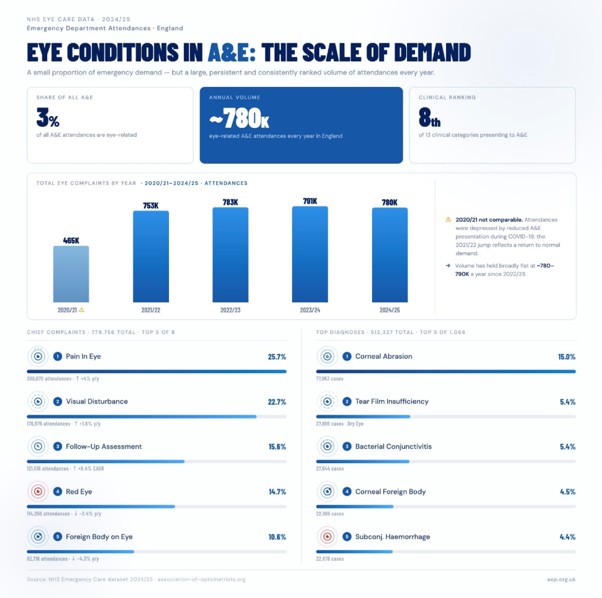
- 780,000 A&E visits in England each year relate to eye problems and conditions
- Analysis suggests hundreds of thousands of these visits could be safely managed in community optometry services, conveniently located on every High Street
- Common eye problems are among the top 10 most common reasons for attending emergency departments in England
- Health experts say eye care services for common problems should be available nationwide, helping patients access faster treatment while reducing avoidable pressure on emergency departments.
New analysis by the Association of Optometrists (AOP) suggests that up to four in five (78%) A&E visits for eye problems could be safely managed in community optometry services, including patients presenting with conditions such as conjunctivitis, dry eye, eye infections and minor abrasions.
Currently, nearly 780,000 A&E visits in England each year are for eye-related conditions, making eye problems, among the top 10 most common reasons people are attending emergency departments. This means that hundreds of thousands of avoidable A&E visits for eye-related issues are occurring each year, adding to the pressure on emergency departments.
NHS-funded services for common eye problems, known as minor and urgent eye care services, allow patients with conditions such as red eyes, infections, flashes and floaters, or sudden changes in vision to be assessed and treated by specially trained community optometrists.
Areas in England with established services have been shown to reduce demand on emergency departments and GP services.
However, access to the service due to inconsistent commissioning across England has created a postcode lottery that leaves many patients without the same care close to home. As a result, many patients do not know where to seek treatment for eye problems and instead go to emergency departments, even when their condition could be managed safely in the community.
Eye health experts, supported by emergency care practitioners, are calling for urgent and minor eye care services delivered by community optometry to be available nationwide.
They say consistent access across England would help patients receive timely treatment in the most appropriate setting, while reducing avoidable pressure on emergency departments and supporting the Government's ambition to shift more care into the community.
Dr James Gagg, Vice President of the Royal College of Emergency Medicine: “It’s no secret that Emergency Departments (EDs) in England are under immense pressure at the moment, and we know our patients are being let down due to overcrowding and unacceptably long waits.
“Utilising community optometry services to ensure there is equitable access across England could save people with a variety of eye health problems from a potentially lengthy trip to a busy ED.
“We would welcome better-resourced community eye care, which could help deflect demand from A&E, accompanied by further measures from government to tackle the root causes of overcrowding and corridor care elsewhere in the system.&rdquo
Adam Sampson, Chief Executive of the Association of Optometrists says: “Emergency departments should not be the default destination to manage eye problems. What this research tells us is that hundreds of thousands of patients each year end up in A&E because they conclude it’s their only option, but they could be treated by the highly trained optometry workforce based in the community. The challenge is not capability – it's consistency. It’s essential we have a service in place for everyone everywhere in England to treat eye problems in the community – the reality of the postcode lottery is that it deprives patients of access to care close to home.
“It is simply a no-brainer that the Government acts to ensure that every member of the public who has an eye problem should be able get the help they need on the High Street, in the same way the public can go to a community pharmacy for a range of health issues, regardless of where they live.”
A 2024 report by PA Consulting for the AOP showed that community optometry already has the clinical expertise, equipment and capacity to manage significantly more clinical care for common eye problems outside hospital settings.
The AOP has written to the Secretary of State for Health and Social Care sharing their newly launched report Taking pressure off Emergency Departments as part of its ongoing Eye care everywhere campaign calling for a nationwide service in England.
The NHS Emergency Care Data Set (ECDS) records reveal there is consistent pressure on the ED service relating to eye care issues.
In 2024/25:
- Eye-related attendances as a proportion of all attendances were 3% – placing ‘eyes’ in the top eight reasons that patients attend
- Total ED attendances were 25,822,265. Total eye-related attendances were 779,756
- Between 62% and 78% of eye-related ED attendances associated with the most common conditions could potentially be deflected.
Ends
Contacts
For interviews with Adam Sampson – Chief Executive of the Association of Optometrists, or any of the other experts mentioned below, please contact edible group on 0207 126 7100 or email [email protected]
Available for comment:
- Dr James Gagg, Vice President of the Royal College of Emergency Medicine
- Adam Sampson, Chief Executive of the Association of Optometrists
- Farah Topia, Optometrist and Clinical Advisor at the Association of Optometrists
- Aishah Patel, Optometrist and Clinical Advisor at the Association of Optometrists
- Ceri Smith-Jaynes, Optometrist and spokesperson for the Association of Optometrists.
About the Research
Research is from the AOP’s report Eyecare everywhere: Taking pressure off Emergency Departments. Findings are based on a rapid review of published NHS England ECDS data 2024/25, focusing on chief complaints, diagnosis coding and trends. Over 1000 different diagnosis codes were identified, and ranked to evaluate the areas of greatest opportunity for A&E attendance reduction.
Conservative assumptions were applied when modelling potential reductions in A&E attendance for eye related presentation. Extracted data graphs from the report are available below.